Dental Crowns
A crown is a custom-made restoration that fully covers a weakened or broken tooth, restoring strength, appearance, and function. Includes implant-supported crowns coordinated with our surgical partners.
About This Service
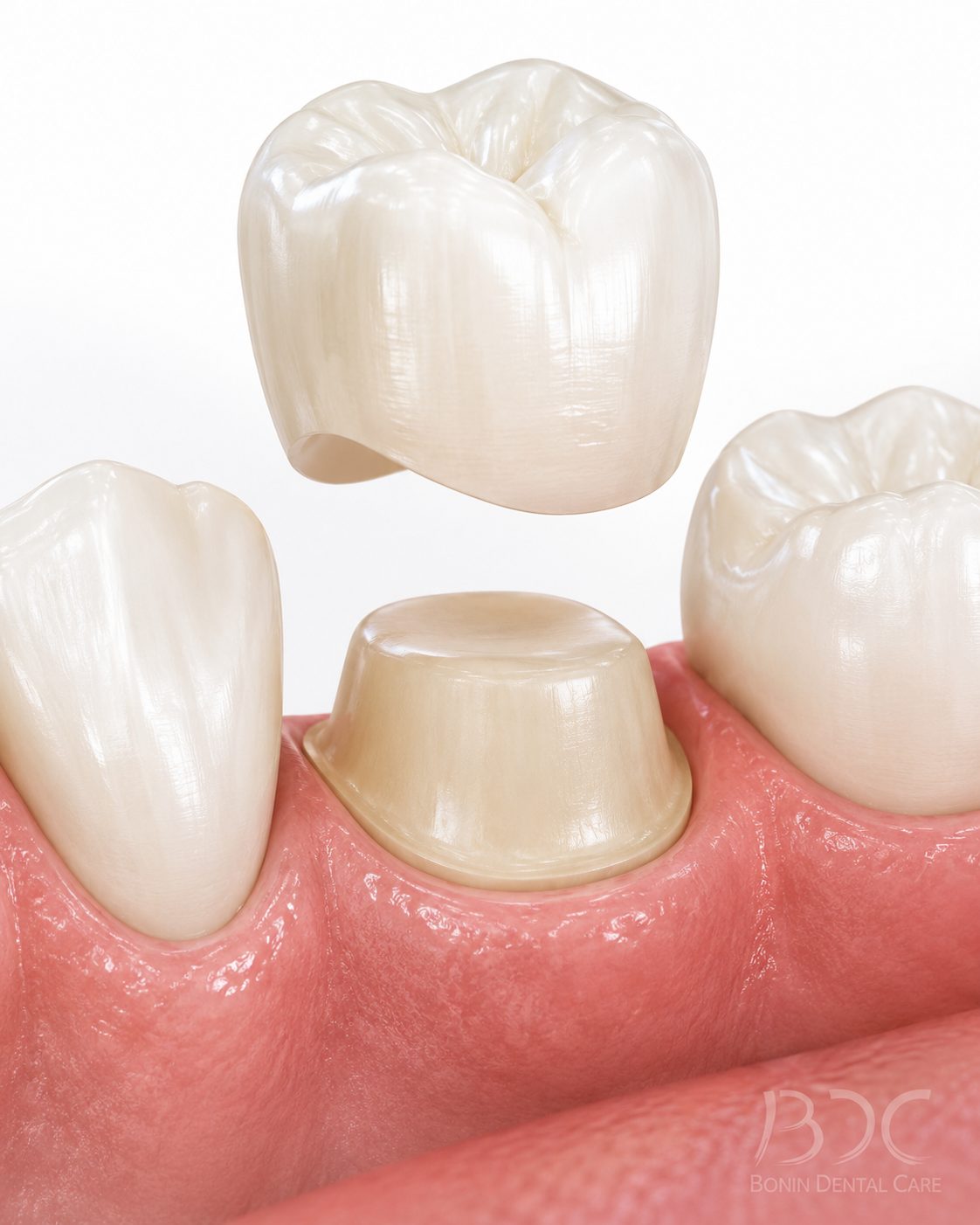
A dental crown is a custom-made restoration that fully covers a tooth that has been weakened by decay, fracture, or a failed filling. When a tooth loses too much structure, a filling won't hold. A previously treated tooth often becomes brittle and needs reinforcement. A badly chipped or cracked tooth can't be fixed with bonding alone. A crown solves all of these by restoring the entire visible tooth with a durable custom restoration that matches your natural teeth. Crowns are also used to complete dental implants: the surgical partner places the implant fixture and Dr. Bonin designs and seats the custom crown that finishes the case.
The beauty of a crown is that it gives you back a tooth that feels, looks, and works like your own. Modern materials come in multiple options. Zirconia crowns are incredibly strong and naturally white, perfect for back teeth or for anyone who wants durability without compromise. Porcelain-fused-to-metal crowns have been reliable for decades, blending strength with excellent appearance. Lithium disilicate (like e.max) offers the best cosmetic results for front teeth, mirroring the translucency of natural enamel. Dr. Bonin helps you choose based on the tooth's location, your bite, and your aesthetic priorities.
At Bonin Dental Care, crown placement is approached as restorative dentistry at its finest. It's not a quick fix; it's a careful decision about materials, fit, and color that shapes your smile for years. Dr. Bonin takes time during your consultation to explain why your tooth needs a crown, what material will serve it best, and what you'll experience during the two-appointment process.
Is This Right For You?
Who Benefits Most From Dental Crowns
You're a good candidate if you have a tooth with a large filling that's failing, a cracked or fractured tooth, a tooth that's had root canal treatment, severe decay in a single tooth, or discoloration that whitening won't fix. Crowns work for patients of any age, from young adults with broken front teeth after trauma to older adults replacing 20-year-old crowns. You should be committed to keeping your teeth; if you have heavy decay throughout your mouth, we may address that first.
You're not an ideal candidate if your tooth is so decayed that only extraction makes sense, or if you're not ready to invest in a restoration that lasts years. Active grinding or clenching changes material choice but doesn't disqualify you. Very young children with baby teeth rarely need crowns, though we use them in specific cases.
Our Approach
Why Patients Choose Bonin Dental Care For Dental Crowns
Dr. Bonin has two decades of crown placement experience. He learned restorative dentistry at Spear Education, one of the most respected postgraduate programs in America, and he brings that precision to every crown. He understands how to shape a tooth to preserve as much healthy structure as possible, taking just enough to provide retention without overpreparation. His shaping technique means less cutting, less trauma, and better long-term tooth survival.
He uses the latest digital scanning technology to capture tooth anatomy in exact detail, reducing remakes and ensuring your crown fits perfectly from appointment two. He offers premium materials: zirconia for strength, e.max lithium disilicate for cosmetics, and traditional porcelain-fused-to-metal for patients who need proven durability. He sits with you on material choice, explaining the trade-offs between strength, appearance, and longevity specific to your tooth's location and your bite.
At Bonin Dental Care, a crown isn't a quick money play. It's a 10-to-15-year solution that Dr. Bonin approaches with the care it deserves. Patients tell us their crowns feel indistinguishable from natural teeth, and they appreciate that we took time to explain each material and didn't rush the fit. Your bite is checked carefully. Your margins (where crown meets tooth) are polished smooth. Follow-up is routine, not reactive.
Patient Benefits
Why patients choose us for dental crowns
- Saves a tooth that would otherwise need extraction or fail from decay.
- Restores full chewing strength, so you eat normally without worrying about breakage.
- Looks identical to your natural tooth, blending seamlessly with your smile.
- Protects the underlying tooth and any root canal work from future damage.
- Lasts 10 to 15 years or longer with proper care and no grinding habits.
- Can be placed over an implant or used alongside other restorations as part of a larger smile makeover.
What to Expect
From First Visit To Final Result
Your consultation covers the tooth's history, why a crown is the best option, and your material choices. You'll see samples of different crown types and ask questions. Dr. Bonin takes photos of your smile, scans or imprints the tooth, and matches color using a shade guide in natural light. If you're anxious about drilling, he'll explain the numbing process and how little sensation you'll feel. The appointment takes 60 to 75 minutes.
During the crown appointment, your tooth is numbed, then shaped. You'll feel vibration and water spray, not pain. You'll hear the drill and see the light, but the sound is much less dramatic than it seems. The numbing remains effective throughout; if you ever feel anything uncomfortable, raise your hand and Dr. Bonin stops and adds more anesthesia. Once shaped, the tooth is scanned and a temporary crown is placed. This temporary protects your tooth and looks decent, though it's not as perfect as your final restoration.
Your crown arrives from the lab one to two weeks later. At your second appointment, the temporary comes off and the permanent crown is tried on. You'll bite on articulating paper so Dr. Bonin can adjust any high points where your bite feels off. Once you approve the appearance and comfort, the crown is bonded on permanently. The whole process from preparation to finished crown takes 10 to 14 days and two visits.
What to Expect
Our Approach
Every visit follows a clear, considered sequence. No surprises, no guesswork.
- 1
Your first appointment begins with an exam and X-rays. Dr. Bonin evaluates the tooth, discusses material options, and numbs the area.
- 2
He removes any old filling, decay, or compromised tooth structure, shaping the tooth to accept a crown.
- 3
A digital scan or impression captures the exact shape; we also match the color of your natural teeth using a shade guide.
- 4
A temporary crown is placed while your custom restoration is made by the lab, protecting the prepared tooth for one to two weeks.
- 5
When your custom crown returns, you return for appointment two. Dr. Bonin removes the temporary, checks the fit and color, and makes adjustments if needed.
- 6
Once you approve the appearance and bite, he bonds the crown to your tooth with permanent adhesive, trimming excess and polishing the margins.
- 7
We check your bite under pressure to ensure it doesn't interfere with your natural closing pattern.
- 8
You receive care instructions and schedule a follow-up in two weeks to confirm no sensitivity and that the margin is healthy.
Know Your Options
How Dental Crowns Compares To The Alternatives
Crown vs. Onlay or Inlay
Inlays and onlays are smaller restorations that cover only the biting surface and some sidewalls, preserving more natural tooth structure. They're great for moderate decay in a single pit or fissure. Crowns cover the entire visible tooth, providing more support and protection, and they're better for teeth with large failures, root canals, or severe cracks. If more than half the tooth's chewing surface is compromised, a crown is typically the stronger choice. If only a single pit needs repair, an inlay or onlay saves more healthy tooth.
Crown vs. Veneer
Veneers are thin shells bonded to the front of teeth, ideal for cosmetic improvements like staining, slight chips, or shape adjustments. They don't cover the biting surface and require minimal tooth removal. Crowns wrap the entire tooth and provide structural support for weakened or broken teeth. If your tooth has large decay, a failed filling, or root canal treatment, a crown is necessary. If your tooth is structurally sound but looks stained or slightly chipped, a veneer may be sufficient and more conservative.
After Your Appointment
Recovery And Long-Term Care
For the first 24 hours, avoid very hot or hard foods; your tooth may be slightly sensitive to temperature while it settles. You can eat normally after the numbing wears off (usually one to two hours), though being gentle for the first few days is wise. Your bite will feel different at first, like a new shoe breaking in. If it feels too high or uncomfortable when you close your teeth, call us back; small adjustments often make a difference.
Long-term care is simple: brush and floss around the crown like a natural tooth. The crown itself doesn't decay, but the underlying tooth and the margin where crown meets tooth do. Don't chew ice, hard candy, or nuts on the crown. If you grind your teeth at night, wear a nightguard to protect your crown and other teeth. Avoid using your teeth as tools. Your crown should last 10 to 15 years or longer; the better you care for your teeth overall, the longer the crown lasts. Regular checkups and cleanings keep the margin healthy and let us catch any problems early.
Before You Decide
Costs, Insurance, And Timing
Crown cost depends on the material you choose. Zirconia and e.max are premium options and cost more than older porcelain-fused-to-metal. Insurance covers part of the cost for most patients; we'll provide an estimate before you commit. Many dental plans cover crowns once every five years. Patient financing options are available to spread payments. The appointment time is two visits, usually one to two weeks apart; the procedure itself is noninvasive and you go home the same day each visit.
Treatment timeline is quick. Preparation visit takes 60 to 75 minutes. The lab then fabricates your crown in one to two weeks. Permanent placement takes 30 to 45 minutes on appointment two. From start to finish, you're wearing a permanent crown within 10 to 14 days. If you want to add cosmetic improvements (like whitening adjacent teeth to match your new crown's shade), that planning happens during consultation.
FAQ
Dental Crowns: Common Questions
Will my tooth be sensitive after the crown is placed?
Why do I need a crown instead of just a filling?
Can I tell the crown from my natural teeth?
What if my crown feels too high when I bite?
How long do crowns last?
What happens if my tooth breaks under the crown?
Can a crown be whitened if it becomes stained?
What material should I choose for my crown?
Have a question we did not cover? Reach out to our team.
Helpful Links
Explore related topics
Whether you are evaluating dental crowns for the first time or planning a comprehensive treatment that combines several procedures, the resources below answer the questions patients in Windsor and across Sonoma County most often ask before booking.
Related Care
About the Practice
Plan Your Visit
Available Across Sonoma County
Dental Crowns for patients in these areas
Each link below opens a page written for that community, with drive times, local landmarks, and specific answers to the dental crowns questions we hear most from your area.
- Dental Crowns for Healdsburg
- Dental Crowns for Santa Rosa
- Dental Crowns for Rohnert Park
- Dental Crowns for Sebastopol
- Dental Crowns for Cloverdale
- Dental Crowns for Larkfield-Wikiup
- Dental Crowns for Mark West Springs
- Dental Crowns for Fulton
- Dental Crowns for Forestville
- Dental Crowns for Petaluma
- Dental Crowns for Sonoma
- Dental Crowns for Oakmont
- Dental Crowns for Cotati
- Dental Crowns for Guerneville
- Dental Crowns for Geyserville
- Dental Crowns for Fountaingrove
- Dental Crowns for Rincon Valley
Related Services