Invisalign Clear Aligners
Nearly invisible clear aligners that straighten your teeth without metal brackets or wires. Discreet, comfortable, and proven.
About This Service
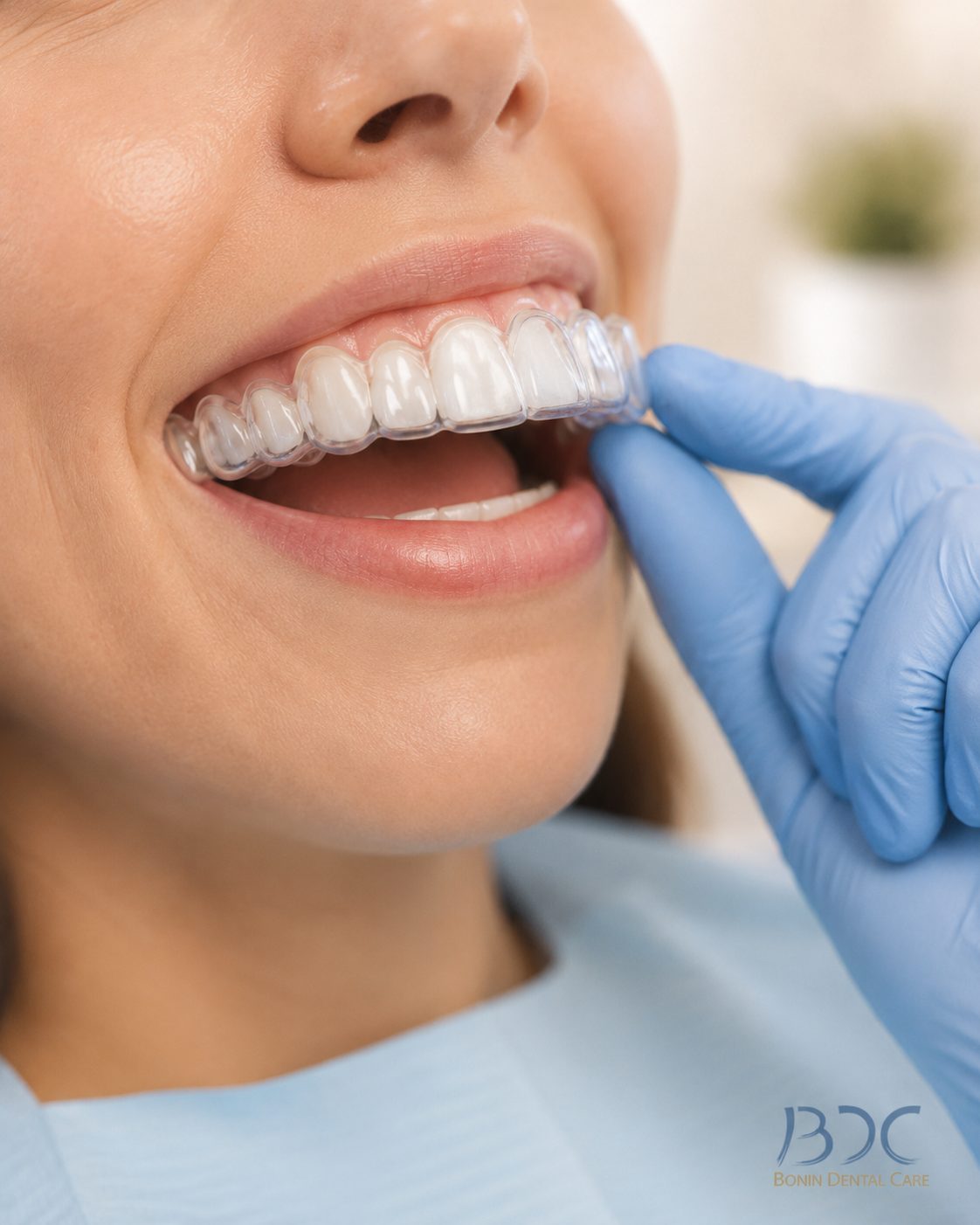
Invisalign clear aligners have changed how adults and teens think about straightening their teeth. Instead of brackets and wires visible on your teeth for years, you wear custom-made plastic trays that gradually move your teeth into alignment. You take them out to eat and brush, and nobody needs to know you're straightening your teeth unless you tell them. For working professionals, public speakers, and anyone self-conscious about traditional braces, Invisalign solves a real problem. Dr. Bonin, a general dentist and certified Invisalign provider, treats Invisalign cases himself in our Windsor office and refers complex orthodontic cases to a board-certified orthodontist.
Invisalign works on mild-to-moderate crowding, spacing, and bite issues. Your teeth might be slightly overlapped, have gaps, or need minor rotational correction. The aligners apply gentle pressure over time, moving each tooth into its target position. Treatment typically takes 6 to 18 months depending on your case complexity. The process is backed by decades of research and millions of successful treatments worldwide.
Dr. Bonin is an Invisalign Silver Provider, meaning he's trained and experienced in clear aligner treatment. He'll evaluate whether Invisalign is right for your specific crowding and bite, or whether traditional braces would work better. Some cases have crowding so severe that braces handle them more effectively. That honesty is important. If Invisalign is the right move, Dr. Bonin will design your plan to get you the best result.
Is This Right For You?
Who Benefits Most From Invisalign Clear Aligners
Invisalign works well for adults and teens with mild to moderate crowding or spacing. If your teeth are slightly overlapped or have small gaps, Invisalign is often a great choice. It's popular with working professionals who don't want visible braces, and with self-conscious teens. You need healthy gums and good oral hygiene to start. Ideally, your permanent teeth have finished coming in (usually by mid-teens), and you're committed to wearing aligners consistently, at least 20-22 hours per day.
Invisalign may not be the best option if you have severe crowding where teeth are badly overlapped, or if your bite problem is complex and needs the more precise control of traditional braces. Some patients also have bite issues that would benefit from skeletal correction that braces handle better. Age isn't a barrier; we've straightened teeth for patients in their 60s and 70s. The key is realistic expectations and willingness to wear the aligners nearly all day, every day.
Our Approach
Why Patients Choose Bonin Dental Care For Invisalign Clear Aligners
Dr. Bonin is an Invisalign Silver Provider with over 24 years of clinical experience and advanced training from USC and the U.S. Navy Residency. He stays current on Invisalign technology and has guided hundreds of patients through clear aligner treatment. He's honest about what Invisalign can and can't do; if your case is better suited to braces, he'll tell you upfront rather than forcing a square peg into a round hole.
Bonin Dental Care uses the latest Invisalign software for treatment planning so you see exactly how your teeth will move before the first aligner goes in. We have all the tools needed for comprehensive treatment, from 3D scanning to digital bite analysis. If you need adjustments mid-treatment, we handle refinements in-house without unnecessary back-and-forth.
In Sonoma County, you'll find many Invisalign providers, but Dr. Bonin combines real orthodontic training, conservative treatment planning, and personal attention. You're not a number moving through a chain. You're a patient with a specific smile goal, and we treat the planning and execution accordingly.
Patient Benefits
Why patients choose us for invisalign clear aligners
- Nearly invisible, so you can straighten teeth without anyone noticing.
- Removable aligners let you eat what you want and maintain normal oral hygiene.
- Faster treatment than traditional braces for many patients, often 6-18 months.
- Comfortable smooth plastic with no sharp brackets or wires.
- Fewer office visits needed compared to braces adjustments.
- Predictable results guided by advanced 3D treatment planning software.
What to Expect
From First Visit To Final Result
Your consultation starts with a conversation about your goals and what's bugging you about your teeth. Dr. Bonin examines your bite, takes photos, and discusses crowding or spacing. He then does a 3D digital scan that becomes your treatment plan. You'll see a preview of how your teeth will shift throughout treatment. This preview is huge; you walk away knowing what to expect. If you're happy with the plan, you schedule to pick up your first set of aligners.
When you get your aligners, Dr. Bonin shows you how to put them in and take them out, explains wear time (20-22 hours daily is necessary), and covers eating and drinking while wearing them (water only). You switch to a new tray every 7-10 days. Most people feel mild pressure for the first day or two of each new tray, which subsides as teeth adjust. You'll return for check-in appointments every 4-6 weeks so Dr. Bonin can monitor progress and ensure the treatment is tracking as planned.
Expect to keep aligners in while at work, school, and social events. You take them out to eat, drink anything but water, and to do your full oral hygiene routine. Some patients find this freeing; others adjust to wearing them as part of their routine. Your first set covers the major movement. Near the end of treatment, you might need refinement aligners to fine-tune positioning. Once treatment is complete, you'll wear retainers nightly to keep your teeth straight long-term.
What to Expect
Our Approach
Every visit follows a clear, considered sequence. No surprises, no guesswork.
- 1
Initial consultation to examine your teeth, bite, and crowding, and discuss whether Invisalign suits your goals.
- 2
3D digital scan or impression of your teeth to create a treatment plan showing how teeth will move step by step.
- 3
Review of the treatment preview with you so you see the start and end result before committing.
- 4
Custom aligners fabricated and delivered; you receive several trays to use in sequence.
- 5
Start wearing Aligner 1 for seven to ten days, then switch to Aligner 2, and so on through your full series.
- 6
Check-in appointments every 4-6 weeks to monitor progress, ensure aligners fit properly, and pick up new trays.
- 7
Final refinement once your teeth reach the target position, including possible refinement aligners for minor tweaks.
- 8
Transition to permanent retainers or nightly retainer wear to keep your newly straight teeth in place long-term.
Know Your Options
How Invisalign Clear Aligners Compares To The Alternatives
Invisalign vs Metal Braces
Metal braces are bonded to each tooth and connected by a wire that your dentist tightens regularly. Braces are fixed in place, so they work continuously, and they're excellent for severe crowding or complex bite problems. Invisalign is removable, so you eat normally and brush easily, but they require compliance; you must wear them 20-22 hours daily. Braces are visible, while Invisalign is nearly invisible. Braces typically take 18-30 months; Invisalign often finishes in 6-18 months. Both are effective. Choose braces if you have severe crowding or complex bite issues that need precise control. Choose Invisalign if your crowding is mild to moderate and you want discretion and convenience.
Invisalign vs Veneers for Crowding
If you have mild crowding and don't like how your teeth look, you might think about veneers instead of straightening. Here's the trade-off: veneers cover the front surface of your teeth to make them look straight and are done in two appointments, so results are fast. But veneers are irreversible; they require tooth preparation and are permanent shells. Invisalign straightens your actual teeth without modifying them, is reversible, and takes longer (months). With Invisalign, you end up with healthy, naturally straight teeth. With veneers on crowded teeth, you're covering the problem rather than solving it. Most cosmetic dentists recommend straightening first if crowding is moderate, then considering whitening or bonding if needed. Invisalign gives you the healthiest long-term result.
After Your Appointment
Recovery And Long-Term Care
As soon as your teeth reach their final position, you transition to retainers. You'll wear a fixed bonded retainer on the inside of your front teeth permanently to prevent shifting. At night, you'll also wear a removable aligner-style retainer. This nightly wear is non-negotiable; if you stop wearing retainers, your teeth will gradually drift back toward their original positions. Many patients wear retainers indefinitely because they want their investment to last. It becomes part of bedtime routine like brushing your teeth.
Your first 48 hours after switching to a new aligner might involve some tenderness as teeth move. This is normal and usually mild. Over-the-counter pain relief helps if needed. Avoid very hard or sticky foods while wearing aligners, and remove them before eating anything. Keep your aligners clean by rinsing them under water and brushing gently; some patients also use aligner cleaner tablets. Visit Bonin Dental Care every 4-6 weeks during active treatment so Dr. Bonin can verify progress and ensure everything is tracking correctly.
Before You Decide
Costs, Insurance, And Timing
Invisalign treatment cost depends on your case complexity and how many aligners you need. Mild spacing that corrects in six months costs less than severe crowding requiring 18 months of treatment. Insurance rarely covers Invisalign because it's considered cosmetic orthodontics. However, if you have dental benefits that cover orthodontics, coverage sometimes extends to Invisalign; we'll check your plan. We offer patient financing options to make clear aligner treatment affordable across multiple months. A detailed estimate is provided at your consultation before you commit.
Treatment duration varies widely. Many patients finish in 6-12 months, while others need 18 months for more significant movement. Your specific anatomy, bite, and crowding determine timing. More severe crowding takes longer. Some patients need refinement aligners toward the end of treatment, which adds a few weeks. Dr. Bonin will give you a realistic timeline at your consultation based on your specific case.
FAQ
Invisalign Clear Aligners: Common Questions
How often do I need to wear my Invisalign aligners?
Can I eat and drink normally with Invisalign?
Will Invisalign work for my severe crowding?
How do I clean my Invisalign aligners?
How long do I have to wear retainers after treatment?
How much does Invisalign cost?
Is Invisalign as effective as braces?
Can I use Invisalign as a teenager?
Have a question we did not cover? Reach out to our team.
Helpful Links
Explore related topics
Whether you are evaluating invisalign clear aligners for the first time or planning a comprehensive treatment that combines several procedures, the resources below answer the questions patients in Windsor and across Sonoma County most often ask before booking.
Related Care
About the Practice
Plan Your Visit
Available Across Sonoma County
Invisalign Clear Aligners for patients in these areas
Each link below opens a page written for that community, with drive times, local landmarks, and specific answers to the invisalign clear aligners questions we hear most from your area.
- Invisalign Clear Aligners for Healdsburg
- Invisalign Clear Aligners for Santa Rosa
- Invisalign Clear Aligners for Rohnert Park
- Invisalign Clear Aligners for Sebastopol
- Invisalign Clear Aligners for Cloverdale
- Invisalign Clear Aligners for Larkfield-Wikiup
- Invisalign Clear Aligners for Mark West Springs
- Invisalign Clear Aligners for Fulton
- Invisalign Clear Aligners for Forestville
- Invisalign Clear Aligners for Petaluma
- Invisalign Clear Aligners for Sonoma
- Invisalign Clear Aligners for Oakmont
- Invisalign Clear Aligners for Cotati
- Invisalign Clear Aligners for Guerneville
- Invisalign Clear Aligners for Geyserville
- Invisalign Clear Aligners for Fountaingrove
- Invisalign Clear Aligners for Rincon Valley
Related Services
Explore related care
Cosmetic Dentistry & Smile Design
Personalized Smile Design combining porcelain veneers, Zoom in-office whitening, Invisalign, bonding, and custom crowns into one coordinated, high-end cosmetic result.
Learn morePorcelain Veneers
Custom porcelain veneers bond to your front teeth to fix color, shape, and minor alignment issues instantly.
Learn more