Implant-Supported Dentures (Coordinated with Surgical Specialists)
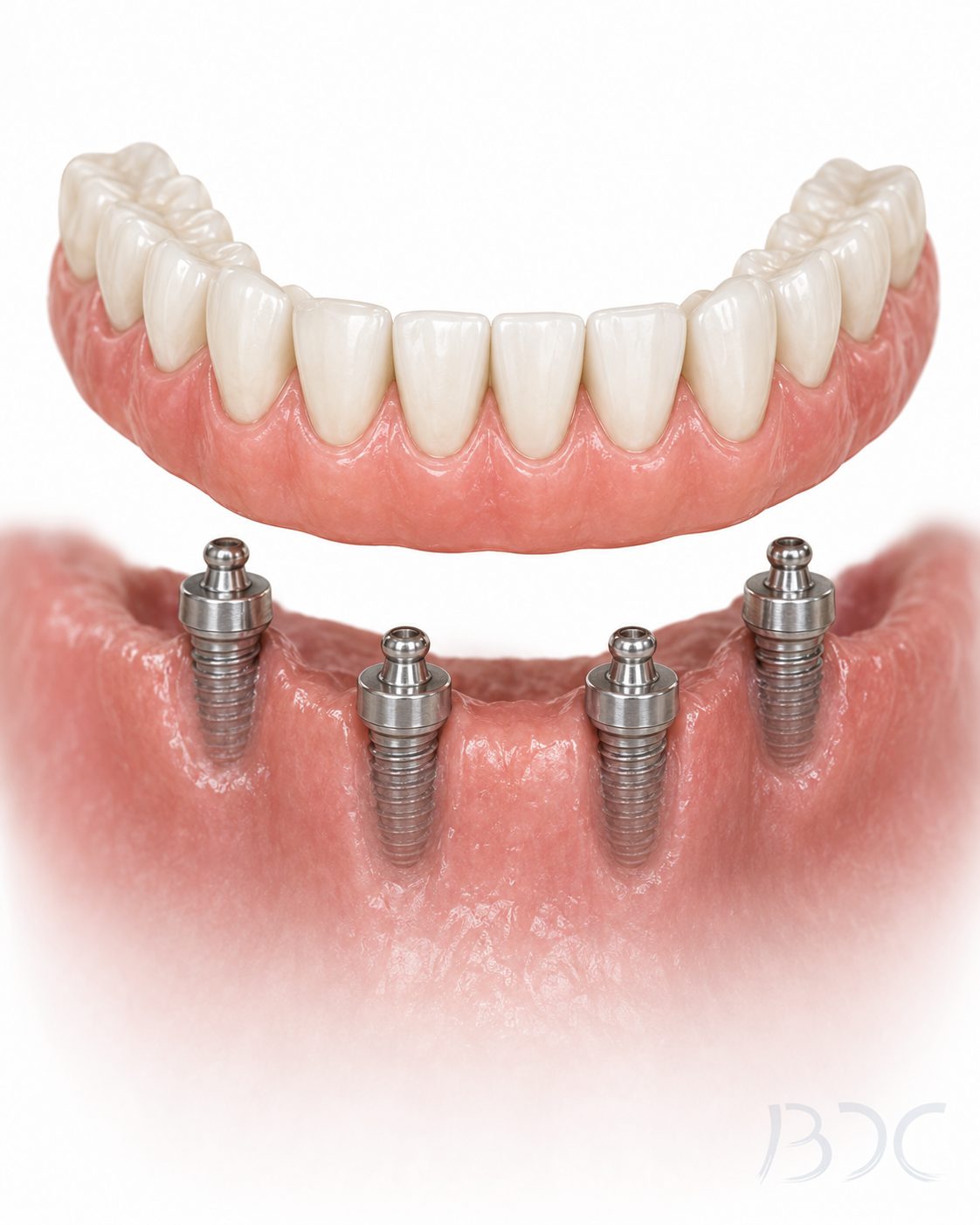
Implant-supported dentures snap onto two to four implants and stay secure all day. Dr. Bonin coordinates the surgical phase with a trusted oral surgeon and designs the custom denture and attachments at our Windsor office.
About This Service
If you're missing most or all of your teeth and tired of traditional dentures that slip, click, or need constant adhesive, an implant-supported denture (sometimes called an overdenture) is often the answer. Instead of relying on suction against your gums, the denture snaps or clips onto two to four implants anchored in your jawbone. You get the stability of fixed teeth with the simpler surgery and lower cost of a removable prosthesis.
Implant-supported denture care is a team effort. The surgical phase, where titanium implants are placed in the jawbone and given time to heal, is performed by a trusted oral surgeon or periodontist Dr. Bonin refers to in Sonoma County. The restorative phase, where a precision-fitting denture is designed, fabricated, and attached to those implants, is performed by Dr. Bonin and our prosthetics lab at Bonin Dental Care. We coordinate the entire process so you have one office quarterbacking every step.
At Bonin Dental Care, we routinely work with patients throughout Windsor and Sonoma County who are done with traditional dentures and ready for something better. A typical case involves two to four implants placed in the lower jaw (upper-jaw implant dentures are also done, but lower is more common). After several months of healing with the surgical specialist, you return to our office and Dr. Bonin designs a custom denture that snaps securely onto those implants. You can remove it for cleaning, but during the day it functions with the stability of fixed teeth.
Is This Right For You?
Who Benefits Most From Implant-Supported Dentures (Coordinated with Surgical Specialists)
You're a good candidate if you're missing all or nearly all your teeth and have adequate jawbone in at least two to four locations where implants can be placed. You don't need perfect bone everywhere (unlike full-arch fixed implants), just enough in specific sites. Good general health and controlled chronic conditions work well. Non-smokers heal faster, but smokers can often proceed with careful post-operative care. You need to be comfortable with basic denture maintenance (removing it, cleaning it, and reinserting it), though the daily routine is simple. Your commitment to implant aftercare and regular dental visits is important.
You may not be a candidate yet if your bone volume is severely compromised across the entire jaw, or if you have uncontrolled gum disease or diabetes. We'll address those issues first. If you're on medications that affect bone healing (like bisphosphonates for osteoporosis), we'll evaluate the risk carefully. Some patients prefer the simplicity of a traditional denture, and that's a valid choice. But if you want the stability and function of implant-supported teeth and want to avoid the cost and complexity of ten to twelve individual implants, an implant-supported overdenture is often the perfect middle ground.
Our Approach
Why Patients Choose Bonin Dental Care For Implant-Supported Dentures (Coordinated with Surgical Specialists)
Dr. Bonin's training in restorative dentistry, combined with his experience guiding Sonoma County patients through complex cases for over two decades, makes him well-suited to coordinate implant-denture treatment from end to end. He completed his DDS at USC and a U.S. Navy General Practice Residency, and he's a member of Spear Education, committing to ongoing advanced training. He understands the surgical considerations that drive a successful outcome, the restorative design that follows, and the lab work that ties the case together. An implant-supported denture requires precise communication between the surgical specialist and the prosthetics lab; Dr. Bonin owns that communication so attachment sites end up positioned perfectly for the final prosthesis he designs.
We use only FDA-approved titanium implants and standardized attachment systems (such as ball attachments or locator connectors) that are reliable and easy to use. The denture base is fabricated from durable acrylic or hybrid materials, and the teeth are either acrylic or higher-strength composite, depending on your preference and bite forces. Our prosthetics lab is experienced with implant-supported cases and delivers precision work. We don't rush the impression or try-in phases. Fit and comfort are everything, because you'll be wearing this denture every day.
Patients choose us because we're honest about what implant dentures can and can't do. They're not identical to fixed implant teeth, but they're vastly superior to traditional dentures. You'll remove yours at night for cleaning (like a traditional denture), but during the day, it functions like fixed teeth. We've seen hundreds of patients transform from frustrated traditional denture wearers to confident implant-supported denture users, and the improvement in quality of life is remarkable.
Patient Benefits
Why patients choose us for implant-supported dentures (coordinated with surgical specialists)
- Surgical phase coordinated with a trusted oral surgeon Dr. Bonin refers to
- Restorative phase (custom denture and attachments) designed by Dr. Bonin at our Windsor office
- Denture stays firmly in place: no more clicking, slipping, or adjusting
- Eat virtually all foods with confidence and full biting power
- Preserve more of your jawbone compared to traditional dentures
- Significantly lower cost than individual implants for each tooth
What to Expect
From First Visit To Final Result
Your initial consultation at Bonin Dental Care involves a detailed examination and 3D X-rays to assess bone in the areas where implants will go. Dr. Bonin explains how many implants you'll need, what the surgery involves, and what the timeline looks like. If you have significant bone loss in certain areas, he'll discuss grafting. You'll learn about attachment options (ball attachments, locators, bar attachments) and what each means for daily use and maintenance. We discuss patient financing options and review your insurance coverage. Most of this appointment is education, so you're making an informed decision.
The surgical phase is performed by the oral surgeon or periodontist Dr. Bonin refers you to. Implant placement is typically done on one or two days under local anesthesia with sedation as needed. If you're having four implants placed, the specialist may do them all in one appointment (60 to 90 minutes) or split into two appointments for comfort. You'll go home with detailed aftercare instructions, pain management guidance, and a soft diet recommendation. Most patients experience mild soreness for a few days, manageable with over-the-counter pain relief and ice. You'll have a follow-up with the surgical office within a week to confirm healing is on track.
After osseointegration is complete (3 to 6 months), you return to Bonin Dental Care for the restorative phase. Taking impressions, designing the denture, and fitting it typically takes 4 to 8 weeks. From the start of the surgical phase to wearing your final denture, plan on 4 to 7 months total.
What to Expect
Our Approach
Every visit follows a clear, considered sequence. No surprises, no guesswork.
- 1
Comprehensive consultation at Bonin Dental Care with 3D imaging to assess bone density and discuss your goals.
- 2
Coordinated referral to a trusted oral surgeon or periodontist for surgical planning, including any minor bone grafting needed.
- 3
Surgical phase: 2 to 4 titanium implants placed into the jawbone by the surgical specialist under local anesthesia and sedation as needed.
- 4
Healing phase lasts 3 to 6 months as bone fuses to each implant. We monitor with the surgical team.
- 5
After healing, you return to Bonin Dental Care for the restorative phase.
- 6
Dr. Bonin captures impressions and a precise scan; our prosthetics lab fabricates the denture base to fit your jaw and complement your face.
- 7
Custom snap attachments or clips are integrated into the denture so it locks securely onto the implants.
- 8
The denture is inserted and adjusted at our office for comfort, bite, and secure retention; we train you on insertion, removal, and daily care.
Know Your Options
How Implant-Supported Dentures (Coordinated with Surgical Specialists) Compares To The Alternatives
Implant-Supported Denture vs Traditional Denture
A traditional denture relies on suction and friction against your gums to stay in place. As your jawbone shrinks (which begins immediately after tooth loss), the fit worsens year after year. It moves when you eat, speak, or laugh. An implant-supported denture snaps securely onto implants, so it doesn't shift. You regain eating ability and speech confidence. The tradeoff is upfront cost and the commitment to implant maintenance. But if you've worn a traditional denture and know its frustrations, the upgrade to implant-supported is life-changing. Most patients never look back.
Implant-Supported Denture vs Full-Arch Fixed Implants
A full-arch fixed prosthesis (All-on-4 or All-on-6) is permanently screwed to six to twelve individual implants and cannot be removed. It's the closest experience to natural teeth, but it requires significantly more implants, more bone, more surgery, and more cost. An implant-supported denture uses fewer implants (2 to 4), is removable for cleaning, and is less invasive. The tradeoff is that you're removing a prosthesis daily, like a traditional denture. If you want fixed, non-removable restoration and have the bone and resources for it, full-arch implants are the goal. If you want a big step up from traditional dentures without the complexity and cost of full-arch, an implant-supported denture is excellent. We have a dedicated page on full-arch implants if that's more aligned with your goals.
After Your Appointment
Recovery And Long-Term Care
For the first 24 to 72 hours after implant surgery, expect mild to moderate swelling, bruising, and discomfort. Take pain relief as directed, use ice to reduce swelling, and eat soft foods. Avoid smoking, alcohol, hot foods, and vigorous rinsing. You can gently rinse with warm salt water after 24 hours. If you experience excessive bleeding, severe pain, fever, or signs of infection, contact us immediately. Most people feel comfortable returning to light activity within a few days.
Once your denture is placed, care is straightforward. Remove it at night and soak it in a denture cleaner solution. In the morning, rinse it, brush it with a soft brush (avoid toothpaste, which can be abrasive), and reinsert it. During the day, avoid hard or sticky foods that could dislodge the denture or damage the attachment clips. Come in for professional cleanings twice yearly, and watch for any looseness in the attachment sites (normal wear over time). The attachment clips or connectors may need tightening or replacement every few years, but this is a simple, inexpensive adjustment. Your implants themselves require no special care beyond regular brushing and flossing around them, but maintaining good gum and bone health is critical to implant longevity.
Before You Decide
Costs, Insurance, And Timing
Cost is driven by the number of implants (typically two to four), any bone grafting needed, the type of attachment system chosen, and the denture fabrication. An implant-supported denture is substantially less expensive than full-arch fixed implants but more than a traditional denture. Most dental insurance plans don't cover implants or the denture itself, though some plans cover a portion of the denture or crown work. We file insurance as a courtesy and offer patient financing options to make treatment accessible. A detailed, itemized estimate is provided before treatment begins.
Timeline depends on bone grafting needs and healing. If you have adequate bone, implant surgery to denture insertion typically takes 4 to 7 months. If you need bone grafting first, add 4 to 6 months for graft healing before implant placement. The actual prosthesis fabrication (impression to finished denture) takes 4 to 8 weeks once healing is complete. Some patients choose a temporary denture during the healing phase, which we can accommodate, but most prefer to wait for the final prosthesis to ensure optimal fit and retention.
FAQ
Implant-Supported Dentures (Coordinated with Surgical Specialists): Common Questions
Will the implant denture feel like real teeth?
Can I sleep with my implant denture in?
What if the attachment points loosen over time?
How many implants do I need for an implant-supported denture?
What if I have very little bone left?
Is the surgery less invasive than full-arch fixed implants?
Can I wear my implant denture immediately after surgery?
What's the cost difference between two and four implants?
Have a question we did not cover? Reach out to our team.
Helpful Links
Explore related topics
Whether you are evaluating implant-supported dentures (coordinated with surgical specialists) for the first time or planning a comprehensive treatment that combines several procedures, the resources below answer the questions patients in Windsor and across Sonoma County most often ask before booking.
Related Care
About the Practice
Plan Your Visit
Available Across Sonoma County
Implant-Supported Dentures (Coordinated with Surgical Specialists) for patients in these areas
Each link below opens a page written for that community, with drive times, local landmarks, and specific answers to the implant-supported dentures (coordinated with surgical specialists) questions we hear most from your area.
- Implant-Supported Dentures (Coordinated with Surgical Specialists) for Healdsburg
- Implant-Supported Dentures (Coordinated with Surgical Specialists) for Santa Rosa
- Implant-Supported Dentures (Coordinated with Surgical Specialists) for Rohnert Park
- Implant-Supported Dentures (Coordinated with Surgical Specialists) for Sebastopol
- Implant-Supported Dentures (Coordinated with Surgical Specialists) for Cloverdale
- Implant-Supported Dentures (Coordinated with Surgical Specialists) for Larkfield-Wikiup
- Implant-Supported Dentures (Coordinated with Surgical Specialists) for Mark West Springs
- Implant-Supported Dentures (Coordinated with Surgical Specialists) for Fulton
- Implant-Supported Dentures (Coordinated with Surgical Specialists) for Forestville
- Implant-Supported Dentures (Coordinated with Surgical Specialists) for Petaluma
- Implant-Supported Dentures (Coordinated with Surgical Specialists) for Sonoma
- Implant-Supported Dentures (Coordinated with Surgical Specialists) for Oakmont
- Implant-Supported Dentures (Coordinated with Surgical Specialists) for Cotati
- Implant-Supported Dentures (Coordinated with Surgical Specialists) for Guerneville
- Implant-Supported Dentures (Coordinated with Surgical Specialists) for Geyserville
- Implant-Supported Dentures (Coordinated with Surgical Specialists) for Fountaingrove
- Implant-Supported Dentures (Coordinated with Surgical Specialists) for Rincon Valley
Related Services
Explore related care
Restorative Dentistry
Comprehensive restorative dentistry rebuilds multiple teeth using crowns, bridges, fillings, implants, and strategic planning.
Learn moreDental Crowns
A crown is a custom-made restoration that fully covers a weakened or broken tooth, restoring strength, appearance, and function. Includes implant-supported crowns coordinated with our surgical partners.
Learn more