Dental Implant Restoration (Surgical Care Coordinated with Specialists)
Dr. Bonin coordinates the surgical placement of your dental implant with a trusted oral surgeon or periodontist, then designs and seats the custom crown that finishes the case at our Windsor office.
About This Service
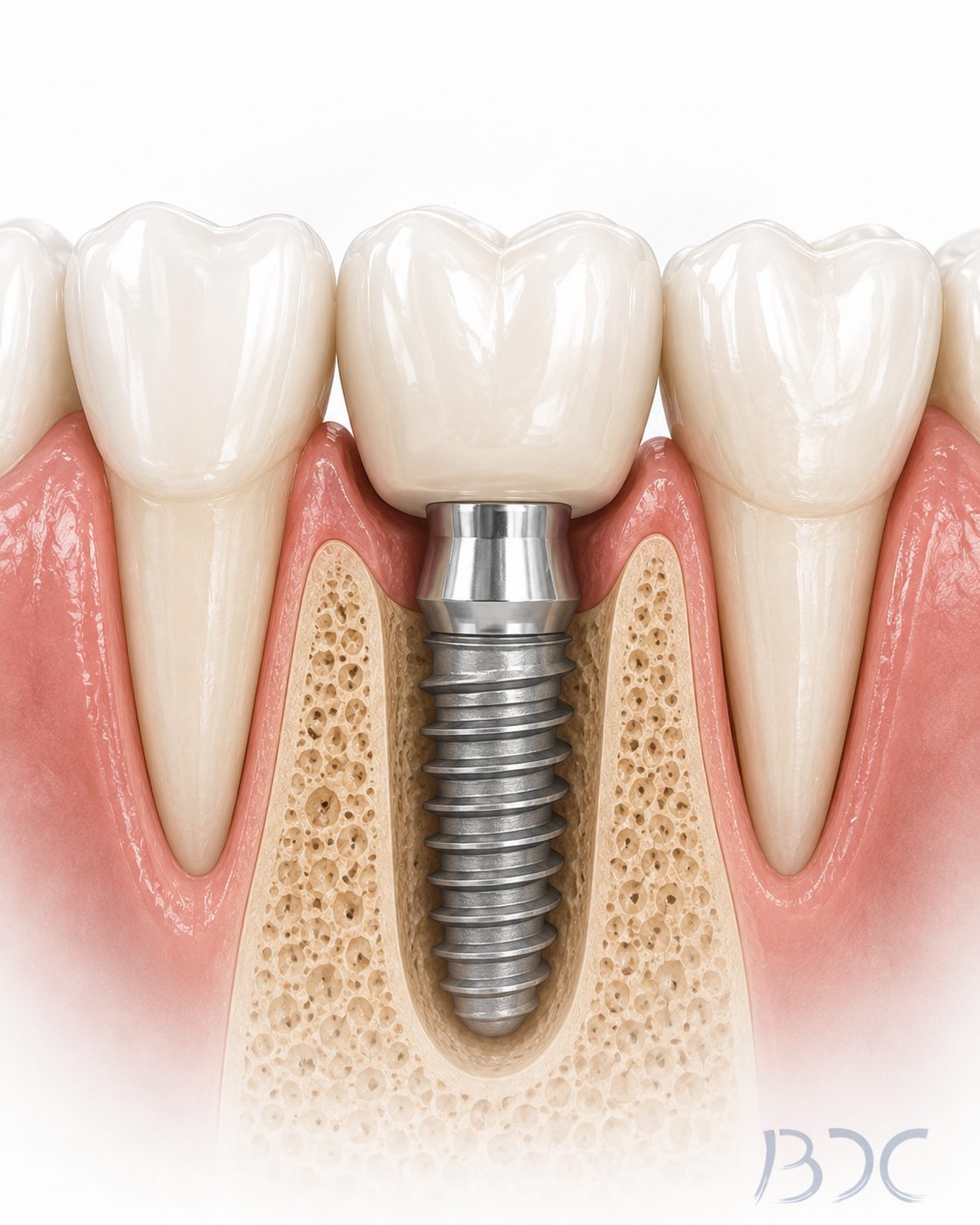
When you lose a tooth, your jaw starts to shift. Other teeth drift into the gap. Your bite changes. Over time, the bone where the tooth was begins to shrink, and your face can change shape. A dental implant solves all of this. It's a titanium fixture anchored into your jawbone, topped with a crown that matches your other teeth. The implant becomes part of your mouth, not a device you wear or remove.
Implant treatment is a two-step team effort: the surgical phase (placing the implant fixture into the bone and managing healing) and the restorative phase (designing and seating the crown that finishes the tooth). Dr. Bonin's philosophy is that each step should be done by the right professional. The surgical phase is handled by a trusted oral surgeon or periodontist Dr. Bonin refers to in Sonoma County. The restorative phase, including the final crown, is designed and placed by Dr. Bonin at Bonin Dental Care. This team-based model is the standard at the highest-quality implant practices, and it delivers better long-term outcomes than asking a single generalist to do both phases at a lower volume.
At Bonin Dental Care, we work with patients throughout Windsor, Sonoma County, and the surrounding region who are ready to restore their smile and bite function. Whether you need a single tooth replaced or several across your lower jaw, we plan the case from start to finish: imaging, consultation, the surgical referral, healing, and the final restoration. You have one office quarterbacking the entire treatment. Dr. Bonin brings over two decades of restorative implant experience and advanced training from some of the field's leading educators to every implant case.
Is This Right For You?
Who Benefits Most From Dental Implant Restoration (Surgical Care Coordinated with Specialists)
You're a good candidate if you're missing one or more teeth and have healthy gums and adequate jawbone density. Implants work best for patients age 18 and up, after jaw growth is complete. You don't need to be in perfect health, but controlled diabetes, heart disease, and other systemic conditions are manageable with the right planning. Non-smokers heal faster and have better long-term outcomes, but smokers can still succeed with careful post-operative care. If you grind your teeth at night, we can recommend a custom nightguard to protect your crown.
Some patients aren't candidates yet, but can be. If you have significant bone loss, you'll need bone grafting first, performed by the surgical specialist. If your gum disease isn't under control, we'll address that in our office before referring you out. If you're a heavy smoker, we'll discuss the realities of healing and maintenance. A few patients have medical or anatomical constraints that make implants unsuitable, but this is rare. Our consultation determines what you need to become a candidate if you aren't quite there yet.
Our Approach
Why Patients Choose Bonin Dental Care For Dental Implant Restoration (Surgical Care Coordinated with Specialists)
Dr. Bonin completed his Doctor of Dental Surgery at the University of Southern California and a U.S. Navy General Practice Residency. He brings 24 years of clinical dentistry to every case, and he is a member of Spear Education, a peer group of dentists committed to ongoing advanced training in restorative procedures. He's trained extensively in implant planning, restorative design, and complex case management. His approach is methodical. Every case starts with high-resolution 3D imaging and a detailed plan. He discusses bone grafting, sinus lifts, and timeline honestly so you know exactly what to expect before treatment begins.
The surgical phase of your implant treatment is performed by a trusted oral surgeon or periodontist Dr. Bonin refers to in Sonoma County. These are specialists whose entire practice is built around surgical placement, who use guided surgery and live imaging, and who have the volume and training to deliver predictable outcomes. We coordinate the referral, send the records and imaging directly, and stay involved throughout the surgical phase. The restorative phase, designing and seating your final crown, is performed by Dr. Bonin at Bonin Dental Care. We use FDA-approved implant systems and high-quality crown materials (zirconia, lithium disilicate, or porcelain-fused-to-gold) chosen for your specific case.
Our patients tell us that the biggest difference is how thoroughly we explain options and how seamlessly the team-based care actually works. You'll never feel rushed. If a bridge, partial denture, or leaving the space open is a better fit for your situation, we'll say so. The practice has been serving Sonoma County since 1993 (originally in Healdsburg, now in Windsor), and implant restoration is a cornerstone of what we do. You're in the hands of a dentist who has restored thousands of smiles and who views every implant as part of a long-term relationship with you.
Patient Benefits
Why patients choose us for dental implant restoration (surgical care coordinated with specialists)
- Surgical placement performed by a trusted oral surgeon or periodontist Dr. Bonin refers to
- Restorative phase (final crown) designed and seated by Dr. Bonin at our Windsor office
- Preserves your jawbone and facial structure long-term
- No need to grind down healthy adjacent teeth as you would for a bridge
- Eat, speak, and smile with confidence and natural function
- Implants look identical to your natural teeth and can last 20+ years with proper care
What to Expect
From First Visit To Final Result
Your first appointment is a comprehensive consultation at Bonin Dental Care. We take 3D X-rays (CBCT), examine your bite and gum health, and discuss your goals. Dr. Bonin explains what implants can and can't do for you, what your bone looks like, and how the team-based treatment works. If you're a candidate, we coordinate the referral to the right oral surgeon or periodontist. If you need a graft first, we explain the timeline for that as well. This consultation is also when we discuss cost drivers, patient financing options, and your insurance coverage.
The surgical phase happens at the specialist's office. They use local anesthesia and offer sedation as needed. The procedure typically takes 30 to 90 minutes depending on the case. You'll feel pressure and vibration but little to no discomfort. Once the implant is in, you'll have specific aftercare instructions, pain management options, and a follow-up plan. We stay in touch with the surgical team during healing.
Once osseointegration is complete (usually 3 to 6 months), you return to Bonin Dental Care for the restorative phase. Dr. Bonin captures a digital scan, designs the abutment and crown, and seats the final restoration. Taking the scan, designing the crown, and placing it typically takes 2 to 4 weeks. From your first consultation to your finished implant, a straightforward single-tooth case usually takes 4 to 8 months. Multi-tooth cases or cases that needed grafting may take longer.
What to Expect
Our Approach
Every visit follows a clear, considered sequence. No surprises, no guesswork.
- 1
Initial consultation at Bonin Dental Care: exam, 3D imaging, discussion of goals, timeline, and cost.
- 2
Coordinated referral to a trusted oral surgeon or periodontist for surgical planning if you're a candidate.
- 3
If needed, bone grafting or sinus lift is performed by the surgical specialist before the implant goes in, with healing time.
- 4
Surgical placement of the titanium implant fixture into the jawbone by the specialist, under local anesthesia and sedation as needed.
- 5
Healing phase: 3 to 6 months while the bone fuses to the implant (osseointegration). We monitor with the surgeon.
- 6
Return to Bonin Dental Care for the restorative phase. Dr. Bonin captures a digital scan and designs the abutment and crown.
- 7
Final crown is custom-milled to match your bite, color, and adjacent teeth, then bonded or screw-retained at our office.
- 8
Long-term follow-up at Bonin Dental Care: hygiene visits, bite checks, and periodic imaging to confirm implant health.
Know Your Options
How Dental Implant Restoration (Surgical Care Coordinated with Specialists) Compares To The Alternatives
Dental Implant vs Bridge
A bridge uses adjacent teeth as anchors. To place a bridge, we prepare two healthy teeth and cover them with crowns that hold a false tooth in the middle. The bridge itself lasts 10 to 15 years, but those supporting teeth are now more vulnerable to decay and may eventually need additional treatment. An implant sits alone and doesn't touch other teeth. It costs more upfront and takes longer, but it preserves your natural teeth and often lasts 20+ years with proper care. If you have two healthy anchor teeth, a bridge might make sense. If those teeth are already compromised or if you want to protect them, an implant is almost always the better choice.
Dental Implant vs Leaving the Gap
Leaving a space open feels like no big deal at first. But your jawbone begins resorbing (shrinking) immediately after you lose a tooth because it's no longer needed for support. Within a few years, neighboring teeth shift into the gap, your bite changes, and your facial support may look different. Implants halt that bone loss and keep your teeth in their natural position. The gap you didn't think mattered can eventually affect how you chew, how your remaining teeth align, and how your face looks. An implant is an investment in your future bite and bone health, not just your appearance.
After Your Appointment
Recovery And Long-Term Care
For the first 24 to 72 hours after the surgical phase, you'll experience some swelling, mild bruising, and discomfort. Follow the surgical specialist's instructions exactly: pain relief as directed, ice to reduce swelling, soft foods (soup, yogurt, mashed vegetables), and rest. Avoid smoking, alcohol, strenuous exercise, and rinsing or spitting forcefully. If you experience excessive bleeding, severe pain, fever, or signs of infection, contact the surgical office immediately. Most people are comfortable enough to return to work within a few days, though healing continues underneath.
Long-term care after your crown is placed at our office is straightforward. Brush gently around the implant and crown, floss or use a water flosser, and come in for regular cleanings every six months. Your crown may eventually need replacement (typically after 10 to 15 years), but the implant fixture itself, if it integrates successfully, can support a new crown for decades. Avoid chewing on hard objects (ice, hard candy), and wear a nightguard if you grind your teeth. Implants are not vulnerable to decay the way natural teeth are, but poor oral hygiene and gum disease can compromise the bone around the implant, so your regular home care and professional cleanings matter tremendously.
Before You Decide
Costs, Insurance, And Timing
Cost depends primarily on the number of implants, the extent of any bone grafting, sinus lift procedures, and the crown material. A single implant with straightforward bone can range from moderate to substantial; multi-tooth cases with complex anatomy cost more. Bone grafting and sinus lifts add time and expense at the surgical office. Most dental insurance plans don't cover implants (they're often categorized as cosmetic), but some plans cover a portion of the crown placed at our office. We file claims as a courtesy. If you don't have insurance coverage, patient financing options are available to help you manage the cost. An itemized estimate is provided before treatment begins, so you'll know exactly what to expect.
Timeline varies considerably. A straightforward single-tooth case with no bone grafting takes 4 to 8 months from consultation to final crown. If you need bone grafting, add 4 to 6 months of healing before the implant goes in. Multi-tooth cases with sinus lifts can take 9 to 12 months or longer. Some protocols offer immediate-load implants (where you get a temporary tooth the same day surgery is done), which can shorten the timeline, but not every patient's bone anatomy allows this. Dr. Bonin will be honest about your timeline during the consultation.
FAQ
Dental Implant Restoration (Surgical Care Coordinated with Specialists): Common Questions
Who performs the surgical part of my implant treatment?
Why don't you place the implants yourselves?
How long do dental implants last?
Will the implant feel like a real tooth?
Is implant surgery painful?
What if I don't have enough bone for an implant?
Can I get an implant if I have diabetes or heart disease?
How do I clean around an implant crown?
Have a question we did not cover? Reach out to our team.
Helpful Links
Explore related topics
Whether you are evaluating dental implant restoration (surgical care coordinated with specialists) for the first time or planning a comprehensive treatment that combines several procedures, the resources below answer the questions patients in Windsor and across Sonoma County most often ask before booking.
Related Care
About the Practice
Plan Your Visit
Available Across Sonoma County
Dental Implant Restoration (Surgical Care Coordinated with Specialists) for patients in these areas
Each link below opens a page written for that community, with drive times, local landmarks, and specific answers to the dental implant restoration (surgical care coordinated with specialists) questions we hear most from your area.
- Dental Implant Restoration (Surgical Care Coordinated with Specialists) for Healdsburg
- Dental Implant Restoration (Surgical Care Coordinated with Specialists) for Santa Rosa
- Dental Implant Restoration (Surgical Care Coordinated with Specialists) for Rohnert Park
- Dental Implant Restoration (Surgical Care Coordinated with Specialists) for Sebastopol
- Dental Implant Restoration (Surgical Care Coordinated with Specialists) for Cloverdale
- Dental Implant Restoration (Surgical Care Coordinated with Specialists) for Larkfield-Wikiup
- Dental Implant Restoration (Surgical Care Coordinated with Specialists) for Mark West Springs
- Dental Implant Restoration (Surgical Care Coordinated with Specialists) for Fulton
- Dental Implant Restoration (Surgical Care Coordinated with Specialists) for Forestville
- Dental Implant Restoration (Surgical Care Coordinated with Specialists) for Petaluma
- Dental Implant Restoration (Surgical Care Coordinated with Specialists) for Sonoma
- Dental Implant Restoration (Surgical Care Coordinated with Specialists) for Oakmont
- Dental Implant Restoration (Surgical Care Coordinated with Specialists) for Cotati
- Dental Implant Restoration (Surgical Care Coordinated with Specialists) for Guerneville
- Dental Implant Restoration (Surgical Care Coordinated with Specialists) for Geyserville
- Dental Implant Restoration (Surgical Care Coordinated with Specialists) for Fountaingrove
- Dental Implant Restoration (Surgical Care Coordinated with Specialists) for Rincon Valley
Related Services
Explore related care
Restorative Dentistry
Comprehensive restorative dentistry rebuilds multiple teeth using crowns, bridges, fillings, implants, and strategic planning.
Learn moreDental Crowns
A crown is a custom-made restoration that fully covers a weakened or broken tooth, restoring strength, appearance, and function. Includes implant-supported crowns coordinated with our surgical partners.
Learn more