

Tooth-Colored Fillings
Tooth-colored composite fillings restore decayed teeth with materials that match your natural smile and bond to tooth structure.
About This Service
A cavity is a hole in your tooth. The decay has eaten through enamel and into the softer dentin layer below. A filling seals that hole and restores the tooth's shape and function. Tooth-colored composite fillings (made of resin and fine ceramic particles) have become the standard because they match your natural tooth color, require less drilling of healthy tooth structure, and bond directly to what remains.
The reason we prefer composite fillings is straightforward: they look better and preserve more of your original tooth. Metal amalgam fillings (which contain mercury, silver, and other metals) are still durable and less expensive in some cases, but they show dark gray inside your mouth, they expand and contract with temperature changes slightly differently than tooth, and they require removing more healthy tooth structure to place them properly. Composite fillings shade-match your tooth, flex slightly like natural tooth does, and bond to the remaining structure, actually reinforcing it.
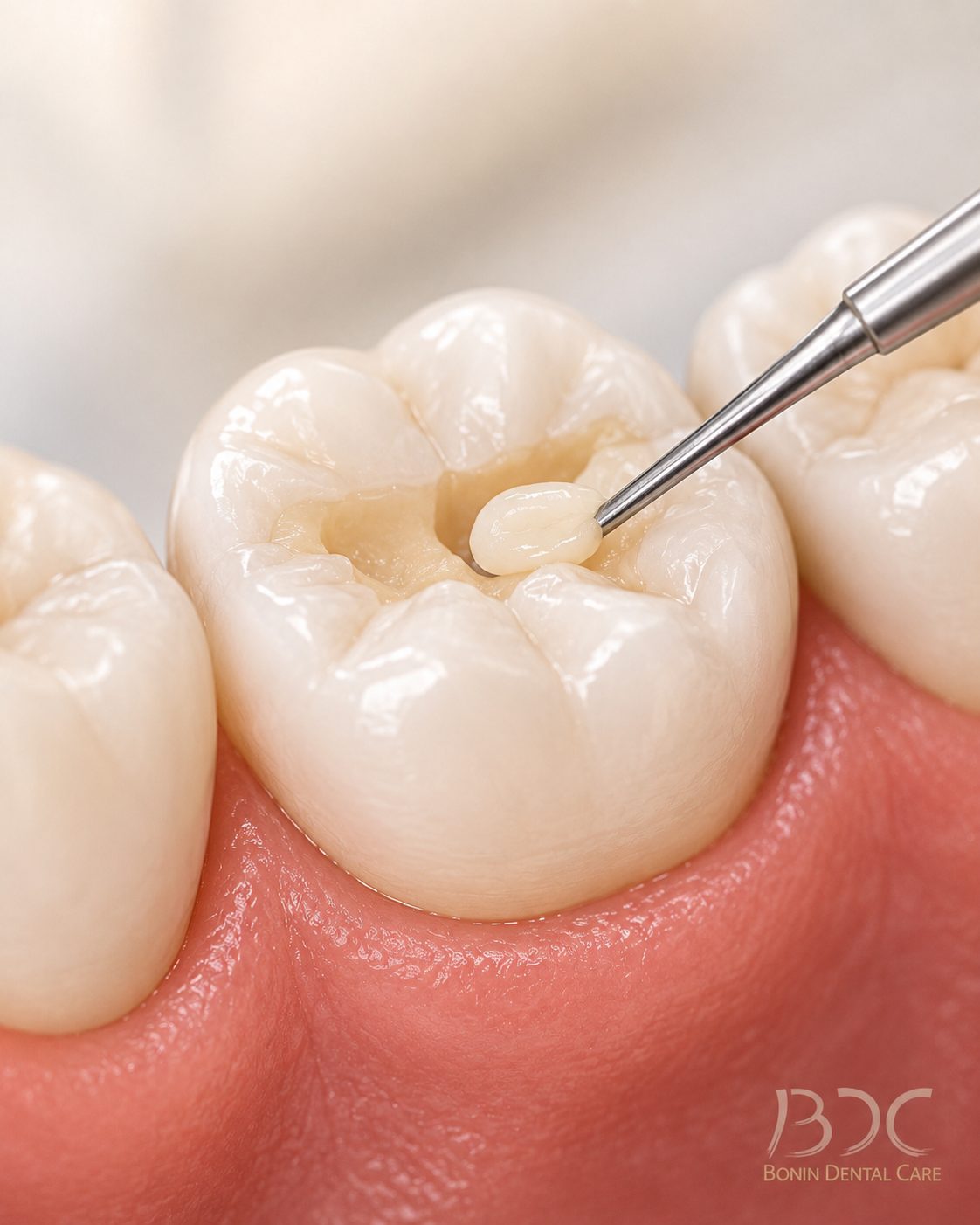
At Bonin Dental Care, we use shade-matching technology and placement techniques that prioritize esthetics and function. Whether you're replacing an old filling that's worn out or treating a newly discovered cavity, Dr. Bonin will use composite resin. The appointment is straightforward: numb the area, remove decay, shape the remaining tooth, place the composite in layers, harden it with special light, and adjust the fit so your bite feels natural.
Is This Right For You?
Who Benefits Most From Tooth-Colored Fillings
Any patient with a cavity is a candidate for a composite filling. This includes children who develop decay despite good hygiene (sugar and invisible plaque spots find everyone), teenagers and working adults managing busy lives, and older adults with existing fillings wearing out. Composite fillings work well for small to moderate cavities. Patients concerned about appearance especially benefit because the filling disappears visually. Patients who want to avoid any mercury or metal in their mouth also choose composite. Patients who grind their teeth can still get composite fillings, though we may recommend discussing protective measures like a night guard.
Patients might not be ideal candidates if the cavity is very large and extends close to the nerve. In those cases, a crown or possibly a root canal may be a better choice. Or if a patient has a very deep bite and significant grinding habits, we might recommend a different restoration after discussing the trade-offs. These conversations happen during your exam.
Our Approach
Why Patients Choose Bonin Dental Care For Tooth-Colored Fillings
Dr. Bonin completed his Doctor of Dental Surgery at USC, where he developed detailed skills in operative dentistry and restorative technique. His U.S. Navy General Practice Residency exposed him to thousands of cases and taught him judgment about material selection and placement. Over 20 years of practice, he's placed thousands of composite fillings and refined his technique to prioritize esthetics and longevity. He's a member of the American Academy of Cosmetic Dentistry, which means he holds himself to high standards for shade matching and functional anatomy.
The materials we use are current. Composite resins have improved dramatically over the last decade. Our shade-matching system allows us to select the exact color of your tooth, accounting for variations in tone and translucency. We use bonding agents and composite brands that have strong clinical track records for longevity and color stability. The placement technique matters enormously. Composite filling success depends on dry conditions, careful layering, and precise curing. Dr. Bonin takes time to do this right, not rushing the appointment.
Patients appreciate that a composite filling feels and functions like a natural tooth from day one. There's no sensitivity to cold from expansion of metal. Your bite feels normal immediately. You can eat soft foods right after the appointment, though we recommend waiting until numbness fully wears off (usually one to two hours). We'll send you home with clear guidance on what to expect and what to avoid in the hours after placement.
Patient Benefits
Why patients choose us for tooth-colored fillings
- Natural color blends seamlessly with your tooth, invisible in smiles and photos.
- Bonded directly to tooth structure, reinforcing what remains rather than weakening it.
- Requires less healthy tooth removal than metal fillings, preserving more of your original tooth.
- White fillings don't expand and contract with hot and cold drinks like metal can.
- Placed in one appointment with no temporary crown or follow-up drilling needed.
- Easy to replace or repair if worn down in the future without major reconstruction.
What to Expect
From First Visit To Final Result
You'll arrive at your appointment and settle into the treatment chair. Dr. Bonin will review the tooth with you before starting, explaining the decay location and the filling plan. He'll apply topical numbing gel (tastes a bit like cherry or bubble gum) to make the injection more comfortable. The anesthetic is given slowly. Most patients feel a small pinch, then gradual numbness spreading through the area over a minute or two. Within a few minutes, you should feel little to no discomfort, though you'll feel pressure and vibration during the procedure.
Once you're numb, Dr. Bonin removes the decay using a handpiece (dental drill) and careful manual technique. You'll hear a whirring sound and feel vibration, but little to no discomfort. He rinses frequently and communicates as he works so you know what's happening. The cavity removal takes anywhere from five to fifteen minutes depending on the size. The smell is a bit medicinal but not unpleasant to most people. You can signal anytime if you need a break.
After decay is removed, the filling process begins. The tooth is treated with conditioning liquids and then bonded. You'll see the tooth may look wet and glossy. Composite resin is placed in incremental layers, each one hardened under a blue light. This layering builds strength and allows the dentist to shape the filling as it hardens. Finally, the filling is polished and contoured so your bite feels natural. The whole appointment typically takes 30 to 50 minutes depending on the cavity size.
What to Expect
Our Approach
Every visit follows a clear, considered sequence. No surprises, no guesswork.
- 1
Local anesthetic is applied and injected around the tooth so you should feel little to no discomfort during the procedure.
- 2
Dr. Bonin uses a drill and special instruments to remove all decay, cleanly and precisely.
- 3
The cavity is shaped to allow the filling material to bond and stay in place structurally.
- 4
The tooth surface is conditioned with a mild acid and then bonded with resin primer.
- 5
Composite resin is placed in layers, each layer hardened briefly under a high-intensity light.
- 6
The filling is shaped and contoured to match your tooth's natural anatomy and bite.
- 7
Fine adjustments are made to your bite so closing your mouth feels completely normal.
- 8
The filling is polished smooth and glossy to match your tooth's natural surface texture.
After Your Appointment
Recovery And Long-Term Care
For the first hour or two after your appointment, your mouth will be numb. Avoid chewing your cheek or lip and be careful drinking hot beverages. Your bite should feel completely normal, but if it feels high or off, call us and we can adjust it. Some patients experience slight sensitivity to cold for a few days after a filling. This typically fades within a week as the tooth settles. Avoid very hot drinks and hard, sticky foods for the first 24 hours. After that, composite fillings are strong and can handle normal eating.
Long-term care is simple. Brush twice daily with fluoride toothpaste and floss daily. Composite fillings last 5 to 10 years or longer, depending on the location and your habits. Fillings in high-stress areas (like teeth you use to chew) may wear or chip over time. Regular checkups help us catch wear early and replace a filling before it becomes a problem. Avoid chewing ice or using your teeth to open packages. If you grind your teeth at night, a protective night guard extends the life of all your restorations.
Before You Decide
Costs, Insurance, And Timing
The cost of a composite filling depends on its size and location. A small filling costs less than a larger one because it uses less material and takes less time to place. Insurance coverage for composite fillings varies; some plans cover them like any other filling, while others cover only the cost equivalent of a metal filling and charge you the difference. We'll verify your coverage before treatment and provide an itemized estimate. Patient financing options are available if needed.
Treatment timing is simple. A single-cavity filling is completed in one appointment. If you have multiple cavities, we prioritize by tooth location and urgency. You might have them done all in one day if you prefer, or spread across two or three visits. This is your choice. Some patients like to get it all done at once. Others prefer shorter appointments. We'll work with your schedule and comfort level.
FAQ
Tooth-Colored Fillings: Common Questions
Will a white filling be obvious or will it blend in with my tooth?
Is it true that composite fillings don't last as long as metal ones?
Can I eat right after my filling appointment?
Will my filling be sensitive to cold?
What happens if my filling breaks or chips?
How do I prevent cavities from coming back?
Can I get a composite filling in a very visible front tooth?
Is the filling procedure painful?
Have a question we did not cover? Reach out to our team.
Helpful Links
Explore related topics
Whether you are evaluating tooth-colored fillings for the first time or planning a comprehensive treatment that combines several procedures, the resources below answer the questions patients in Windsor and across Sonoma County most often ask before booking.
Related Care
About the Practice
Plan Your Visit
Available Across Sonoma County
Tooth-Colored Fillings for patients in these areas
Each link below opens a page written for that community, with drive times, local landmarks, and specific answers to the tooth-colored fillings questions we hear most from your area.
- Tooth-Colored Fillings for Healdsburg
- Tooth-Colored Fillings for Santa Rosa
- Tooth-Colored Fillings for Rohnert Park
- Tooth-Colored Fillings for Sebastopol
- Tooth-Colored Fillings for Cloverdale
- Tooth-Colored Fillings for Larkfield-Wikiup
- Tooth-Colored Fillings for Mark West Springs
- Tooth-Colored Fillings for Fulton
- Tooth-Colored Fillings for Forestville
- Tooth-Colored Fillings for Petaluma
- Tooth-Colored Fillings for Sonoma
- Tooth-Colored Fillings for Oakmont
- Tooth-Colored Fillings for Cotati
- Tooth-Colored Fillings for Guerneville
- Tooth-Colored Fillings for Geyserville
- Tooth-Colored Fillings for Fountaingrove
- Tooth-Colored Fillings for Rincon Valley
Related Services
Explore related care
General Dentistry
Comprehensive exams, professional assessments, and preventive strategies designed to catch problems early and keep your smile healthy.
Learn moreDental Cleanings
Professional cleanings remove tartar and buildup that home care cannot reach, preventing decay and gum disease.
Learn more