Sedation & Anxiety Dentistry
Oral conscious sedation and nitrous oxide (laughing gas) help anxious patients complete necessary dental care in a calm, comfortable state. Dr. Bonin takes the time to know you, educate you, and choose the right approach.
About This Service
Dental anxiety affects millions of people, and it often keeps them from seeking the care they need. If you've avoided the dentist because of fear, a sensitive gag reflex, or the stress of longer procedures, our sedation and anxiety dentistry program offers a real solution. The most important thing we do is not the medication. It is the time. Dr. Bonin sits with you, listens to what you have been through, and educates you about every option before you choose anything. Most patients tell us that simply being heard changes how they feel about treatment.
Sedation does not put you under general anesthesia. Instead, it relaxes your mind and body using nitrous oxide (laughing gas) or oral conscious sedation (a prescription medication taken before your appointment). Both options keep you conscious and responsive but free you from anxiety and awareness of time passing. For patients in Windsor, Santa Rosa, and Sonoma County who have delayed treatment for years, our approach is often the key that finally unlocks the ability to move forward.
The clinical benefit goes beyond comfort. When a patient is relaxed, Dr. Bonin can work more efficiently and complete more dentistry in fewer appointments. Instead of breaking treatment into multiple shorter visits, he can accomplish comprehensive restorative work, complex extractions, or extensive cleanings in one or two sessions. That reduces the number of times you need to come in and means you reach your treatment goals faster. It is also medically safer for patients with certain health conditions that make prolonged stress risky.
At Bonin Dental Care, sedation is presented honestly. It is not for every patient or every procedure. Simple cleanings or minor fillings rarely need it. But for patients facing significant dental work, a history of traumatic dental experiences, or a deeply ingrained fear, oral conscious sedation or nitrous oxide (laughing gas) becomes part of a personalized plan designed to move your dental health forward without unnecessary suffering. Dr. Bonin screens every patient carefully, reviews medical history and medications, and monitors you throughout the appointment. Your safety and comfort are always the priority.
Is This Right For You?
Who Benefits Most From Sedation & Anxiety Dentistry
The ideal candidate for sedation is someone with genuine dental anxiety, a strong gag reflex, or a history of avoiding care due to fear. This includes patients who need longer procedures, extractions, multiple fillings, or restorative work that would benefit from being completed in fewer appointments. Parents of very anxious children often start with nitrous oxide; when a child needs deeper sedation, Dr. Bonin refers the family to a pediatric dental specialist. Patients with a medical history of trauma during past dental visits, those with certain neurological or developmental conditions, and patients with health issues like severe high blood pressure or heart problems (when monitored carefully) are often good candidates. Older adults, younger adults, and teenagers can all benefit if the clinical situation and medical screening support it.
Not everyone needs or should have sedation. If your anxiety is mild or your procedure is short, nitrous oxide (laughing gas) alone or no sedation at all may be the right choice. Pregnant women typically avoid sedation unless absolutely necessary, and it's not appropriate for patients with allergies to the sedative medications or certain medical conditions. Patients who cannot arrange a designated driver should not undergo oral conscious sedation. Dr. Bonin will discuss these factors during your consultation and recommend what makes sense for your specific situation.
Our Approach
Why Patients Choose Bonin Dental Care For Sedation & Anxiety Dentistry
Dr. Scott Bonin brings 24 years of clinical dentistry to sedation and anxiety dentistry. He completed his Doctor of Dental Surgery at USC and a U.S. Navy General Practice Residency, during which he gained extensive experience using sedation in diverse patient populations. He's a member of the American Dental Association and the California Dental Association, and he trains continually at Spear Education, one of the nation's premier institutes for advanced clinical dentistry. His approach is evidence-based and patient-centered. He doesn't use sedation reflexively or oversell it. Instead, he takes the time to know you, evaluates your actual needs and anxiety level, and chooses the lightest approach (or none at all) that will let treatment proceed comfortably. This conservatism protects you and keeps the experience straightforward.
The practice uses modern monitoring equipment and follows safety protocols that meet or exceed industry standards. Every sedation patient receives a thorough pre-screening, including questions about medical history, medications, and previous reactions to sedative medications. Oxygen levels, heart rate, and blood pressure are tracked continuously throughout your appointment. Dr. Bonin maintains sedation certifications and stays current on best practices through ongoing education. The clinical environment is calm and designed to reinforce the message that this is a safe, controlled experience. Your comfort and safety during sedation are never secondary to completing treatment quickly.
Bonin Dental Care has earned 5.0-star reviews from 225+ patients, many of whom specifically mention how the practice helped them overcome dental fear. Being in Windsor with easy access from Healdsburg, Santa Rosa, Rohnert Park, and Sebastopol means less travel stress. The practice files insurance claims as a courtesy and offers patient financing options if cost is a concern. You're not just getting sedation. You're getting a dentist who takes the time to understand why you've avoided care, who respects your fear, and who personally educates you so you can make the decision that's right for you.
Patient Benefits
Why patients choose us for sedation & anxiety dentistry
- Overcome dental anxiety and decades-long avoidance of needed care.
- Complete more complex treatment in one or two visits instead of many.
- Remain conscious and responsive while your mind stays calm and relaxed.
- Experience no memory of time passing during longer procedures.
- Reduce overall stress on your body during extensive dental work.
- Move through treatment faster and achieve your smile goals sooner.
What to Expect
From First Visit To Final Result
Your sedation consultation usually takes 30 to 45 minutes, and the most important part is the conversation. Dr. Bonin asks detailed questions about your medical history, any surgeries or hospital experiences, current medications, and past reactions to sedative medications. He listens to what has caused your anxiety and what specifically you want to be different this time. He then walks you through each option, including nitrous oxide (laughing gas) and oral conscious sedation, covering recovery time, driving ability, and how long each lasts. You'll have a chance to ask every question. The goal is for you to feel informed, comfortable, and ready. Depending on what you choose, Dr. Bonin will give you specific pre-appointment instructions. For oral conscious sedation, you'll be told to eat a light breakfast or lunch, wear loose clothing, and arrange your designated driver in advance.
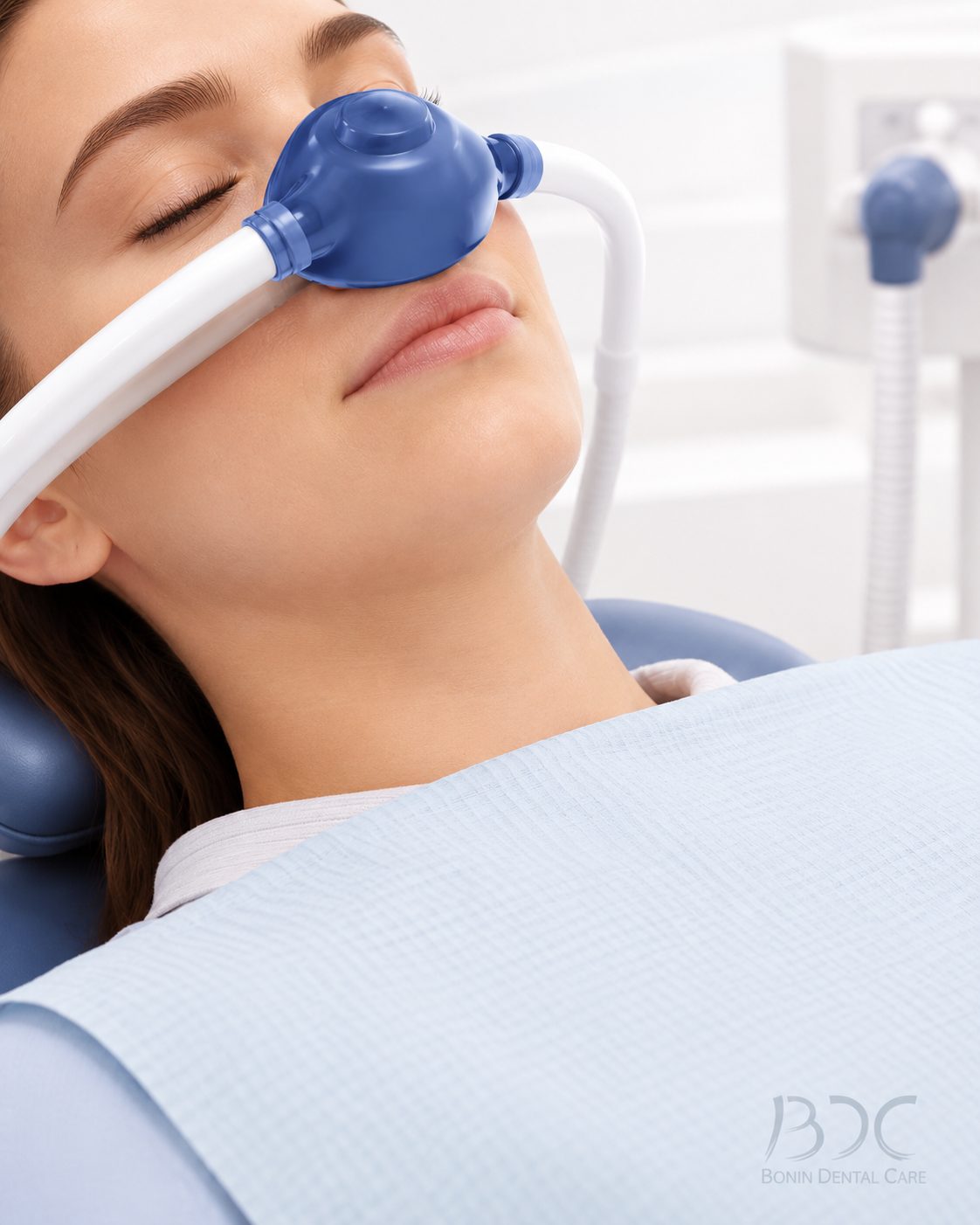
On the day of your appointment, you'll arrive a few minutes early and settle into a treatment room. If you're receiving oral conscious sedation, you'll take the prescribed medication and wait about 30 minutes for it to take effect. You may feel drowsy, a bit lightheaded, and unconcerned about what's happening next. That's the medication working. For nitrous oxide (laughing gas), Dr. Bonin will place a small, comfortable mask over your nose, and you'll breathe normally. Within a few minutes, you'll feel deeply relaxed and calm. Time seems to pass in seconds. You remain aware and can respond to Dr. Bonin's questions, but you won't worry about the sounds, sensations, or details of treatment. He completes your planned dentistry while you rest. For some patients, the experience feels dream-like. Others drift in and out of light sleep.
After your appointment, recovery depends on which option you received. Nitrous oxide (laughing gas) wears off within 5 to 10 minutes of stopping the gas. Dr. Bonin will remove the mask and deliver oxygen for a few minutes to clear the gas completely. You may feel a brief rush of energy, then return to normal within 15 minutes. You can drive yourself home, return to work, or resume normal activities. Oral conscious sedation takes longer to clear from your body. You'll rest in the office for 30 to 60 minutes as the drowsiness begins to lift. Your designated driver will take you home, where you should rest for several hours. Avoid driving, operating machinery, or making important decisions for the rest of the day. Most people feel completely normal by the next morning. Some minor grogginess can linger into the evening, so plan to relax at home.
What to Expect
Our Approach
Every visit follows a clear, considered sequence. No surprises, no guesswork.
- 1
Step 1: You come in for a consultation where Dr. Bonin reviews your medical history, current medications, and why you're interested in sedation.
- 2
Step 2: He takes the time to educate you on each option and recommends the lightest approach that will let treatment proceed comfortably.
- 3
Step 3: For nitrous oxide (laughing gas) appointments, you breathe through a small mask while the calming gas enters your system within minutes.
- 4
Step 4: For oral conscious sedation, you take a prescription medication at home or in the office about 30 minutes before treatment begins.
- 5
Step 5: Vital signs including oxygen levels are monitored throughout your appointment using a pulse oximeter and other standard equipment.
- 6
Step 6: Dr. Bonin completes your planned treatment while you rest in a calm, deeply relaxed state with minimal awareness of time or procedure details.
- 7
Step 7: After nitrous oxide (laughing gas), oxygen is delivered for a few minutes to clear the gas from your system, and you can drive home within 15 minutes.
- 8
Step 8: After oral conscious sedation, a designated driver takes you home where you rest for several hours until the medication fully wears off.
Know Your Options
How Sedation & Anxiety Dentistry Compares To The Alternatives
Nitrous Oxide (Laughing Gas) vs Oral Conscious Sedation
Nitrous oxide, often called laughing gas, is the gentler option. You breathe it through a small mask, and it takes effect in minutes. You feel deeply relaxed and calm, time seems to pass quickly, and you have minimal to no memory gaps. The best part: it wears off completely within 5 to 10 minutes of stopping the gas. You can drive yourself home, return to work, and resume normal activities immediately. Nitrous oxide (laughing gas) is ideal for patients with mild to moderate anxiety who need a shorter procedure or prefer minimal recovery time. The cost is lower because the medication and monitoring are straightforward. Oral conscious sedation is more potent. You take a prescription medication (usually a benzodiazepine) about 30 minutes before your appointment, either at home or in the office. It produces deeper relaxation and significant memory gaps, so the appointment feels like it was over in seconds. For extensive procedures or severe anxiety, oral conscious sedation is often the better choice because you're more profoundly calm and unaware. The tradeoff is recovery time. You'll feel drowsy for several hours and need a designated driver. You can't drive or make decisions until the next day. If you have a busy schedule or no one to drive you, oral conscious sedation is less practical. Many patients benefit from nitrous oxide (laughing gas) for routine care and oral conscious sedation for major restorative work.
Sedation vs No Sedation
For a simple cleaning, routine exam, or minor filling, most patients don't need sedation. Local anesthesia handles any discomfort, and the appointment is short enough that anxiety rarely becomes a barrier. Sedation adds cost and recovery time that aren't justified for straightforward visits. However, if you have deep-seated dental fear, a traumatic past experience, a very strong gag reflex, or need complex treatment that would take several hours, sedation changes the equation. Without it, you might white-knuckle through the appointment or, more likely, avoid it altogether. That avoidance leads to larger problems and treatment becomes more extensive and more expensive over time. Sedation breaks that cycle. It lets you get necessary work done before problems compound. Dr. Bonin will honestly discuss whether sedation makes sense for your specific case. If it does, it's not an indulgence. It's an investment in finally moving your dental health forward.
After Your Appointment
Recovery And Long-Term Care
In the immediate 24 hours after oral conscious sedation, avoid driving, signing important documents, or making major decisions while the medication is still clearing your system. Eat soft, cool foods as your mouth adjusts. Your teeth may feel sore if extensive work was done, and you may want to take over-the-counter pain relief as directed. Avoid hot foods and drinks for the first few hours. If you had dental anesthesia injected during treatment, the numbness will wear off in 2 to 4 hours. Be careful not to bite your cheek or lip while numb. After nitrous oxide (laughing gas), you can eat and drink normally right away. Drink plenty of water to help your body flush the gas and stay hydrated. Some patients feel a slight headache after nitrous if they're dehydrated, so avoid alcohol for at least 24 hours and drink more water than usual. Resume your normal routine the same day.
Long-term aftercare depends on what dental work Dr. Bonin completed. If you had fillings, crowns, or other restorations, follow the specific care instructions he provides for each type. If teeth were extracted, you'll need to follow post-extraction protocols to protect the healing sites. Maintain excellent oral hygiene by brushing twice daily and flossing once daily. Attend your regularly scheduled cleanings every six months or as recommended. If you developed dental fear because of poor oral health, sedation gives you the chance to reset. Use this opportunity to establish a healthier routine so future visits feel less daunting. Most patients who've experienced sedation report that one successful appointment under sedation rebuilds their confidence for routine care going forward.
Before You Decide
Costs, Insurance, And Timing
The cost of sedation depends on the option you choose and the complexity of the treatment being performed. Nitrous oxide (laughing gas) is less expensive because it requires minimal additional equipment and monitoring, and you're in the chair for a standard appointment length. Oral conscious sedation costs more because it requires additional pre-screening, closer monitoring, and longer chair time for recovery before you can leave safely. Your specific procedures, the number of teeth involved, whether extractions or complex restorations are needed, all factor into your total treatment cost. A personalized estimate will be provided at your consultation after Dr. Bonin reviews your case. Most PPO dental insurance plans cover a portion of routine dental procedures and may cover some monitoring or facility fees related to sedation, though policies vary. The practice files insurance claims as a courtesy and offers flexible patient financing options if out-of-pocket costs are a concern.
Your treatment timeline starts with a consultation, often scheduled a week or two in advance. For straightforward cases requiring one sedation appointment, treatment can often be completed in a single visit. For more complex cases requiring multiple sedated appointments, plan on spacing them 1 to 2 weeks apart to allow initial healing between procedures. Some patients prefer spacing appointments further apart for personal reasons, and that's fine. From initial consultation to final result, a comprehensive treatment plan might span 2 to 4 months depending on the scope. If you're in Sonoma County and have avoided dental care for years, that timeline might feel slow. But it's a significant acceleration compared to the months or years you may have spent avoiding the dentist. Discuss your timeline goals with Dr. Bonin at your consultation.
FAQ
Sedation & Anxiety Dentistry: Common Questions
Is sedation dentistry safe?
Do I need a driver after nitrous oxide (laughing gas)?
Will I remember my appointment?
What should I eat before oral conscious sedation?
How long does oral conscious sedation last?
Can I use sedation for a routine cleaning?
What if I have a health condition like high blood pressure or diabetes?
Is sedation and anxiety dentistry covered by insurance?
Have a question we did not cover? Reach out to our team.
Helpful Links
Explore related topics
Whether you are evaluating sedation & anxiety dentistry for the first time or planning a comprehensive treatment that combines several procedures, the resources below answer the questions patients in Windsor and across Sonoma County most often ask before booking.
Related Care
About the Practice
Plan Your Visit
Available Across Sonoma County
Sedation & Anxiety Dentistry for patients in these areas
Each link below opens a page written for that community, with drive times, local landmarks, and specific answers to the sedation & anxiety dentistry questions we hear most from your area.
- Sedation & Anxiety Dentistry for Healdsburg
- Sedation & Anxiety Dentistry for Santa Rosa
- Sedation & Anxiety Dentistry for Rohnert Park
- Sedation & Anxiety Dentistry for Sebastopol
- Sedation & Anxiety Dentistry for Cloverdale
- Sedation & Anxiety Dentistry for Larkfield-Wikiup
- Sedation & Anxiety Dentistry for Mark West Springs
- Sedation & Anxiety Dentistry for Fulton
- Sedation & Anxiety Dentistry for Forestville
- Sedation & Anxiety Dentistry for Petaluma
- Sedation & Anxiety Dentistry for Sonoma
- Sedation & Anxiety Dentistry for Oakmont
- Sedation & Anxiety Dentistry for Cotati
- Sedation & Anxiety Dentistry for Guerneville
- Sedation & Anxiety Dentistry for Geyserville
- Sedation & Anxiety Dentistry for Fountaingrove
- Sedation & Anxiety Dentistry for Rincon Valley