Dental Bridges
A dental bridge replaces one or more missing teeth by anchoring a custom restoration to neighboring teeth.
About This Service
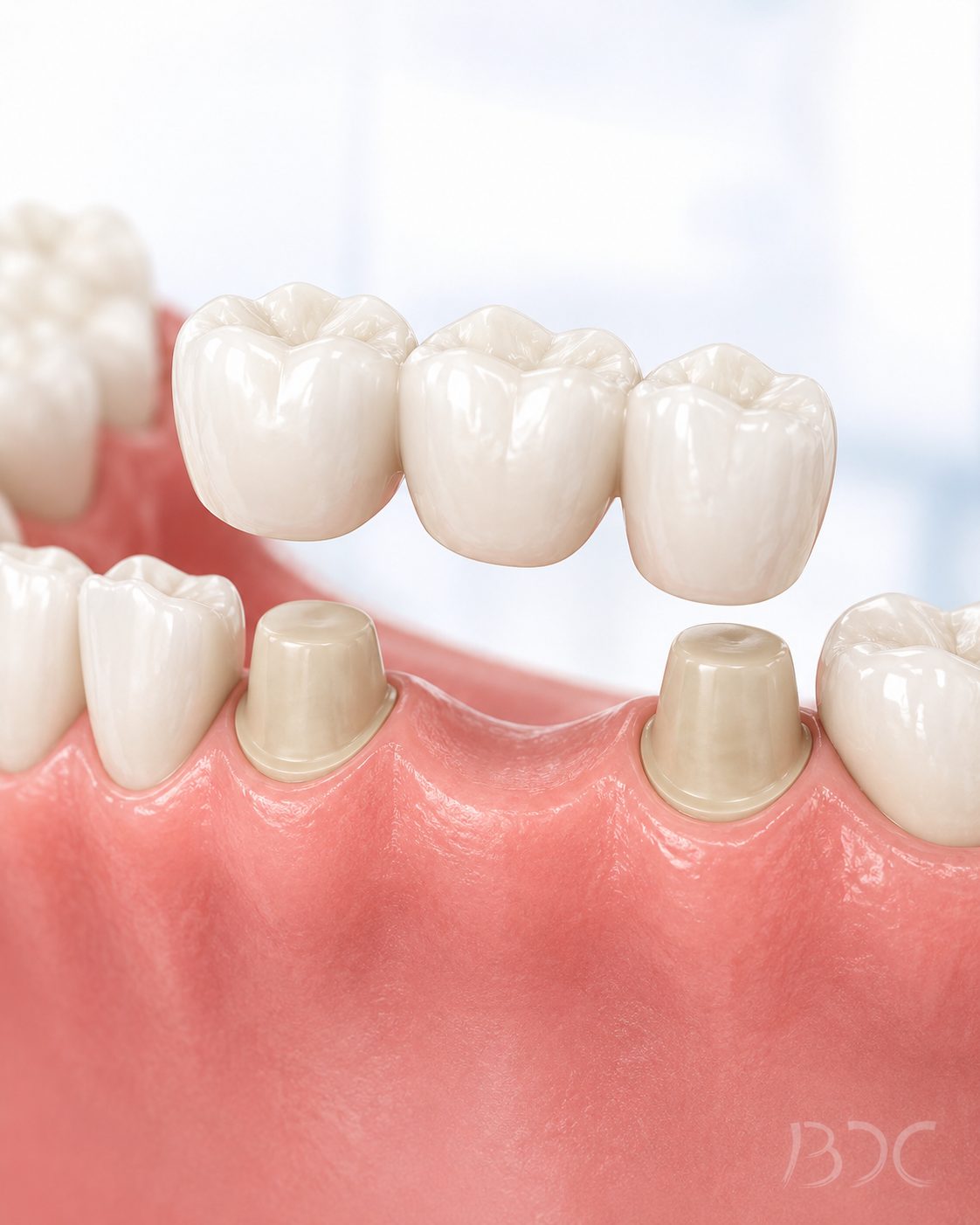
A dental bridge is a fixed restoration that spans a gap left by one or more missing teeth. It's called a bridge because it literally bridges the space, held in place by crowns on the neighboring teeth (called abutment teeth). Unlike a removable partial denture, a bridge is cemented in permanently, so it feels like your own teeth. You brush and floss around it, you eat normally, and your speech doesn't change.
A bridge restores your ability to chew properly, which matters more than people realize. When you're missing a tooth, you naturally shift your chewing to the other side, overloading those teeth and unbalancing your jaw. A bridge puts your bite back in symmetry. It also stops the slow drift of neighboring teeth into the empty space, which can wreck your alignment over years. And it fills the visible gap so your smile looks complete.
At Bonin Dental Care, we place several kinds of bridges depending on your anatomy. A traditional bridge requires preparing two teeth (one on each side of the gap). A cantilever bridge works when there's only one stable tooth next to the gap. A Maryland bonded bridge preserves more tooth structure by bonding to the back of abutment teeth rather than covering them with full crowns. Dr. Bonin examines your teeth and explains which option makes sense for your situation, focusing on what's best for the long term, not just the short-term budget.
Is This Right For You?
Who Benefits Most From Dental Bridges
You're a good candidate if you're missing one to three consecutive teeth and have stable, healthy teeth on either side of the gap to serve as anchors. Your abutment teeth should have no decay and enough bone support to handle the extra load. If your abutment teeth are already crowned or have large fillings, a bridge can crown them and serve double duty. You're an excellent candidate if the gap is visible when you smile and you want it restored quickly.
You're not an ideal candidate if the abutment teeth are heavily decayed, have weak roots, or are at risk for future failure. If you have aggressive gum disease, you should address that before placing a bridge. If the gap is very large (three or more teeth), an implant or implant-supported bridge might be better than relying on teeth as anchors.
Our Approach
Why Patients Choose Bonin Dental Care For Dental Bridges
Dr. Bonin has extensive experience fabricating and placing bridges that fit perfectly and last. He understands that a bridge is only as good as the abutment teeth supporting it, so he takes great care in how he prepares them, preserving as much healthy tooth structure as possible while ensuring the bridge has proper retention. He works closely with our lab to ensure the shape of the artificial tooth (pontic) is sculpted to direct forces correctly and doesn't create a biological dead zone where food and bacteria get trapped.
His bridge planning is strategic. He looks at bone levels, the position of the gap in your smile, and your bite pattern to choose between a traditional bridge, cantilever, or Maryland bonded option. He's skilled in Maryland bridges, which preserve more tooth structure by bonding to the backs of abutment teeth rather than fully covering them. This makes sense for some patients and is often overlooked by dentists who default to traditional bridges.
At Bonin Dental Care, a bridge is treated as a precision restoration. The color match is meticulous; we take time to shade the artificial tooth so it looks indistinguishable from your other teeth. The margin where the bridge meets the abutment teeth is polished smooth so it resists plaque and stays healthy long-term. You're taught exactly how to clean under the pontic using a floss threader or water flosser, because that space is where decay can hide if it's neglected.
Patient Benefits
Why patients choose us for dental bridges
- Stops neighboring teeth from shifting into the gap and ruining your alignment.
- Restores full chewing function so you eat what you want, on both sides of your mouth.
- Looks and feels like a natural tooth once placed; you'll forget it's a restoration.
- Feels more natural than a removable partial because it's fixed in place and doesn't move.
- Lasts 10 to 15 years or longer if your abutment teeth stay healthy.
- Can be placed faster than implants, which require months of healing and bone integration.
What to Expect
From First Visit To Final Result
Your consultation is relaxed and thorough. You'll see X-rays and discuss why the gap needs filling, the options (implant, bridge, partial denture), and what each involves. If you have questions about how a bridge affects the abutment teeth, or whether your teeth are strong enough, Dr. Bonin answers honestly. He'll explain that a bridge transfers some chewing force to the adjacent teeth, and while they're usually strong enough to handle it, this is something to monitor long-term.
On preparation day, you'll be numbed, and the abutment teeth are shaped. It feels much like a crown preparation. You'll hear the drill and feel water spray, but not pain. Once shaped, impressions are taken (or a digital scan is made) and a temporary bridge is placed to hold the space and let you function. The entire appointment takes 60 to 90 minutes.
After one to two weeks, you return for delivery. The permanent bridge is tried on; you'll bite down to check the fit and Dr. Bonin may adjust the pontic (the artificial tooth) if it doesn't feel right. Once you're satisfied with appearance and comfort, the bridge is permanently cemented on. You're given a floss threader and shown how to clean under the pontic. Total time from start to finish is two appointments over 10 to 14 days.
What to Expect
Our Approach
Every visit follows a clear, considered sequence. No surprises, no guesswork.
- 1
Your initial consultation includes X-rays and an exam of the gap and adjacent teeth. Dr. Bonin assesses bone level, tooth strength, and your bite to determine the best bridge type.
- 2
He discusses your options, including whether a bridge, implant, or partial denture makes most sense, and what each would cost and take.
- 3
If you choose a bridge, the abutment teeth are numbed and shaped to accept crowns, much like a single crown preparation.
- 4
Impressions or scans are taken of the prepared teeth and the gap, capturing the exact space the bridge needs to fill.
- 5
A temporary bridge is placed to maintain the space and let you function while the permanent one is fabricated at the lab.
- 6
After one to two weeks, you return. The temporary is removed and the finished bridge is tried in, checked for fit and color, and your bite is verified.
- 7
Once approved, the bridge is bonded to the abutment teeth with permanent cement, and excess is cleaned away.
- 8
You're given instructions on how to clean under the pontic (the artificial tooth that spans the gap) and scheduled for a follow-up in two weeks.
Know Your Options
How Dental Bridges Compares To The Alternatives
Bridge vs. Implant
A bridge is finished in two appointments over 10 to 14 days. An implant takes six to nine months from placement to final crown. A bridge uses your existing teeth as anchors and can replace multiple missing teeth. An implant is a single replacement; you need one per missing tooth. A bridge preserves more bone because the pontic (artificial tooth) rests on the gum, maintaining that ridge. An implant integrates into bone and stimulates it. A bridge is less expensive upfront; implants cost more. A bridge doesn't require the bone height that implants do. Both last many years with proper care. Choose a bridge if you want speed and your abutment teeth are sound. Choose an implant if you want independent tooth replacements and bone preservation is a priority.
Bridge vs. Removable Partial Denture
A partial denture (partials) is a removable appliance held by clasps on your natural teeth. You take it out to clean it, and it moves slightly when you chew. A bridge is fixed; you don't remove it, and it doesn't move at all. A bridge feels more like a natural tooth. A bridge is better for chewing force distribution and comfort. Partials are easier to adjust and don't require reshaping abutment teeth. Partials cost less upfront but may be less comfortable and require more maintenance. If you're missing back teeth and cost is the main concern, a partial might work. If you want the most comfortable, natural-feeling restoration and your abutment teeth are strong, a bridge is superior.
After Your Appointment
Recovery And Long-Term Care
For the first 24 hours, avoid very hot foods and be gentle with the bridge; your tissues may be tender. After that, you can eat normally. The critical aftercare task is keeping the space under the pontic clean. Plaque and food trap there easily, leading to decay on the abutment teeth or gum disease if neglected. Dr. Bonin will give you a floss threader; thread your floss under the pontic and clean beneath it daily. Alternatively, a water flosser works well.
Brush and floss your bridge like your natural teeth, paying extra attention to the margins where the bridge meets the abutment teeth. Avoid chewing very hard foods or ice on the bridge. Don't use your teeth as tools. If you grind at night, wear a nightguard. Your bridge should last 10 to 15 years or longer. The abutment teeth sometimes develop decay or gum disease if home care slips; this is why good hygiene matters. Regular checkups and professional cleanings help us catch problems early. If the bridge ever feels loose or develops any gap, call us immediately; a loose bridge can trap food and damage the abutment teeth.
Before You Decide
Costs, Insurance, And Timing
Cost depends on how many teeth the bridge replaces and the materials chosen. A single-tooth bridge (three units: two crowns plus one pontic) costs less than a three-tooth bridge (five units). Zirconia and premium porcelain cost more than standard materials. Most insurance covers 50% after you meet your deductible. We provide an estimate before starting so you know the full cost. Patient financing options are available.
Timeline is fast. Preparation is one appointment; the lab makes the bridge in one to two weeks; delivery and cementation is the second appointment. From consultation to finished bridge is typically 10 to 14 days. This is much faster than an implant (six to nine months) but slower than having nothing. If you're in a hurry, a bridge is the quickest restoration. If you want your abutment teeth to be preserved long-term, be prepared that a bridge transfers some force to them, and they may eventually need retreatment.
FAQ
Dental Bridges: Common Questions
How do I clean under the bridge?
Will a bridge damage the abutment teeth?
How long does a bridge last?
Can a bridge be removed and replaced?
What if food keeps getting stuck under my bridge?
Is a bridge better than an implant?
Can a bridge replace multiple teeth?
Will my bridge look natural?
Have a question we did not cover? Reach out to our team.
Helpful Links
Explore related topics
Whether you are evaluating dental bridges for the first time or planning a comprehensive treatment that combines several procedures, the resources below answer the questions patients in Windsor and across Sonoma County most often ask before booking.
Related Care
About the Practice
Plan Your Visit
Available Across Sonoma County
Dental Bridges for patients in these areas
Each link below opens a page written for that community, with drive times, local landmarks, and specific answers to the dental bridges questions we hear most from your area.
- Dental Bridges for Healdsburg
- Dental Bridges for Santa Rosa
- Dental Bridges for Rohnert Park
- Dental Bridges for Sebastopol
- Dental Bridges for Cloverdale
- Dental Bridges for Larkfield-Wikiup
- Dental Bridges for Mark West Springs
- Dental Bridges for Fulton
- Dental Bridges for Forestville
- Dental Bridges for Petaluma
- Dental Bridges for Sonoma
- Dental Bridges for Oakmont
- Dental Bridges for Cotati
- Dental Bridges for Guerneville
- Dental Bridges for Geyserville
- Dental Bridges for Fountaingrove
- Dental Bridges for Rincon Valley
Related Services
Explore related care
Restorative Dentistry
Comprehensive restorative dentistry rebuilds multiple teeth using crowns, bridges, fillings, implants, and strategic planning.
Learn moreDental Crowns
A crown is a custom-made restoration that fully covers a weakened or broken tooth, restoring strength, appearance, and function. Includes implant-supported crowns coordinated with our surgical partners.
Learn more