Root Canal Care (Coordinated with Trusted Endodontists)
When the pulp inside a tooth is infected or inflamed, the right answer is the right specialist. Dr. Bonin diagnoses, coordinates care with trusted endodontists in Sonoma County, and restores the tooth once treatment is complete.
About This Service
A throbbing tooth that wakes you at night, pain when you bite down, or sensitivity to hot that lingers after the heat is gone, these are often signs that the pulp inside your tooth is infected or severely inflamed. The pulp is the living core of your tooth: blood vessels, nerve tissue, and connective tissue. When it gets infected, it doesn't heal on its own. The infection spreads, pain intensifies, and you're heading toward tooth loss if you don't address it.
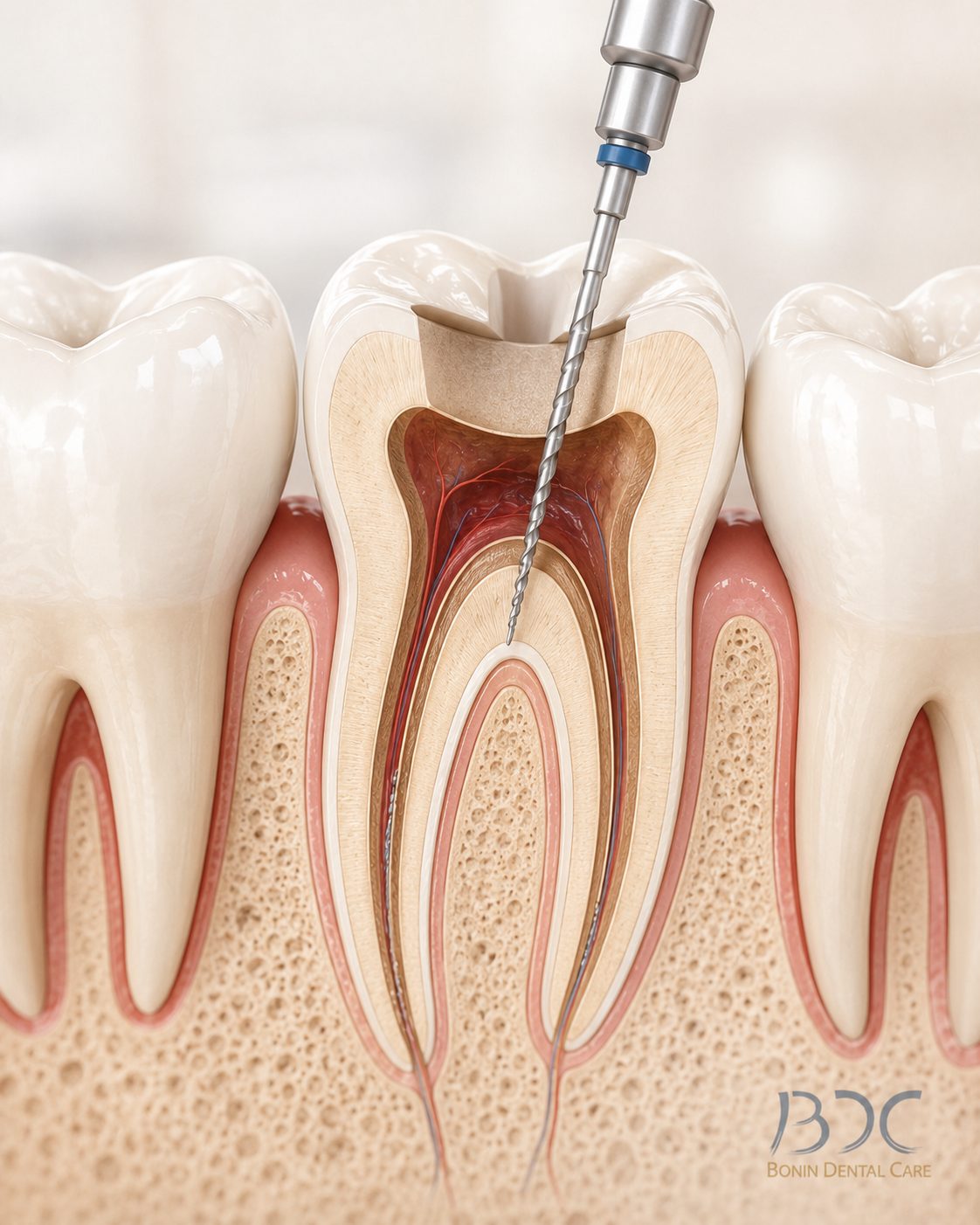
Dr. Bonin's philosophy is simple: he wants the best outcome for you, even when that means coordinating your care with a specialist. For root canal therapy, the best outcomes come from board-certified endodontists who treat these procedures every day with surgical microscopes, advanced rotary instruments, and dedicated training in microsurgery and pulp biology. That's why Bonin Dental Care works with a small group of trusted endodontists in Sonoma County who share our standard of care, communicate with us throughout treatment, and return you to our office for the final restoration.
You're not on your own. Dr. Bonin handles the diagnosis, takes the X-rays and CBCT imaging if needed, confirms whether root canal treatment is the right path or whether another option would serve you better, manages pain relief and antibiotics in the meantime, makes the referral to the right specialist, and then designs and seats the crown or restoration that protects the tooth long-term. From your first symptom to the finished restoration, you have one office quarterbacking the whole process.
Is This Right For You?
Who Benefits Most From Root Canal Care (Coordinated with Trusted Endodontists)
You may need a root canal if you have a tooth with an infected or severely damaged pulp. Common scenarios: pain with biting or chewing that comes and goes, pain at night that over-the-counter painkillers don't fix, sensitivity to temperature that lingers long after the stimulus is gone, swelling or a pimple-like bump on your gum near the tooth, or discoloration of the tooth (it may look darker than surrounding teeth). Often we diagnose the need during an exam or imaging when you're already having pain. Age doesn't matter; root canal care is appropriate for younger teeth and older teeth.
You may not be a candidate if the tooth is so damaged that it can't be restored, if the crown of the tooth is severely broken down and can't hold a restoration, or if you have advanced gum disease affecting that tooth. In those cases, extraction and replacement may be the better option. We evaluate tooth by tooth, and we'll be honest about whether saving the tooth is realistic. When it is, we coordinate the specialist care that gives you the best chance at long-term success.
Our Approach
Why Patients Choose Bonin Dental Care For Root Canal Care (Coordinated with Trusted Endodontists)
Dr. Bonin's philosophy is that the best dentist for the job is the dentist whose entire practice is built around that job. For root canal therapy, that means a board-certified endodontist with a surgical microscope, advanced training in microsurgery and pulp biology, and a daily case volume that keeps their skills sharp. Dr. Bonin has spent 24 years in Sonoma County building relationships with the endodontists who consistently deliver the outcomes he wants for his patients. When he refers you, he's referring you to someone he would send his own family to.
The advantage of being a Bonin Dental Care patient is that you don't manage the handoff. We send your records, X-rays, and any CBCT imaging directly to the specialist. We brief them on your medical history and any anxiety considerations. We schedule the follow-up restoration with our office so the tooth isn't left vulnerable. And we stay accountable for the full outcome, not just the part we performed. This is what we mean by coordinated care: one office quarterbacking specialists, materials, and follow-up so the result is what you actually need.
What patients tell us afterward is that the process felt simple even though specialists were involved. They never wondered who to call, never had to repeat their history, and never had to chase records between offices. And when the pain that brought them in is finally gone, they're grateful they kept the natural tooth rather than extracted and replaced it.
Patient Benefits
Why patients choose us for root canal care (coordinated with trusted endodontists)
- Specialist-level root canal care from a board-certified endodontist Dr. Bonin trusts
- Diagnosis, pain relief, and a clear plan from the office that already knows your mouth
- Saves your natural tooth, avoiding extraction and replacement work down the line
- Coordinated handoff and communication between our office and the endodontist
- Final crown or restoration designed and seated by Dr. Bonin at Bonin Dental Care
- One point of contact (our office) for the entire process, even when treatment is referred
What to Expect
From First Visit To Final Result
Your first appointment after you experience pain may be an emergency or urgent care visit at our office. We'll examine the tooth, take X-rays to confirm whether root canal therapy is the right answer, and assess whether the tooth is salvageable or if extraction is necessary. If treatment is needed, we'll discuss what to expect, manage your immediate pain, and coordinate the referral to the right endodontist.
On the day of your specialist appointment, plan to be there for 60 to 90 minutes depending on tooth anatomy and treatment complexity. Front teeth with single roots are usually faster; back teeth with multiple roots take longer. The endodontist starts with topical numbing and local anesthetic, then works under a surgical microscope to clean and shape each canal. You won't feel sharp pain with effective anesthetic; mostly pressure, vibration, and water spray. A temporary restoration is placed at the end of the appointment to protect the tooth.
After the anesthetic wears off, the tooth may feel tender for a few hours to a day or two, but it should be significantly less painful than it was before treatment. Within two to four weeks, you return to our office so Dr. Bonin can place the permanent restoration, almost always a crown that protects the now-brittle tooth from fracture. From your first call about pain to a fully restored tooth, the typical timeline is two to six weeks.
What to Expect
Our Approach
Every visit follows a clear, considered sequence. No surprises, no guesswork.
- 1
Dr. Bonin examines the tooth, reviews X-rays and imaging, and confirms whether root canal therapy is the right answer or if another approach would serve you better.
- 2
If treatment is needed, we provide immediate pain management and antibiotics if appropriate, so you are comfortable while care is scheduled.
- 3
We make a coordinated referral to a trusted endodontist in Sonoma County, share your records and imaging, and explain what you can expect at that appointment.
- 4
The endodontist performs the root canal treatment using a surgical microscope and modern instrumentation, then places a temporary restoration.
- 5
We follow up with the endodontist to confirm the treatment outcome, then bring you back to our office for the permanent restoration.
- 6
Dr. Bonin scans or impressions the tooth and designs a crown or restoration that protects the tooth and matches your natural smile.
- 7
The crown is bonded permanently, your bite is checked, and we walk you through long-term care.
- 8
You return for hygiene checkups so we can monitor the treated tooth and the crown over time.
Know Your Options
How Root Canal Care (Coordinated with Trusted Endodontists) Compares To The Alternatives
Root Canal Therapy vs Tooth Extraction and Replacement
Extraction is cheaper upfront but often more expensive long term. After extraction, you need a replacement: an implant with a crown (surgical placement by an oral surgeon, healing time, restoration), a bridge (requires preparing adjacent teeth, less ideal if those teeth are healthy), or a denture (removable, requires adjustment, doesn't feel like a natural tooth). Root canal therapy saves your natural tooth. A natural tooth, even one treated by an endodontist, typically has better long term function and longevity than a replacement. The conservative, tooth-saving approach is usually the better one when it's clinically possible.
Root Canal Therapy vs Extraction with Implant
An implant feels natural and looks natural once it's healed and restored, but it's a surgical procedure performed by an oral surgeon, followed by months of healing, and finally a crown placed by Dr. Bonin at our office. Total timeline is typically 6 to 12 months. Cost is higher than root canal therapy, especially with the crown. Some patients aren't candidates for implants if they don't have adequate bone. An implant is a great solution for a tooth that's already lost or truly unsalvageable, but if your tooth can be saved by an endodontist, saving it avoids surgery and usually costs less. If the root canal fails years later (rare), you still have the implant option at that point. Try to save the tooth first.
After Your Appointment
Recovery And Long-Term Care
Your tooth will feel sore for a day or two after treatment, similar to the sensitivity you feel after a deep filling. This is normal and manageable with over-the-counter pain relief if needed. Avoid chewing on the treated tooth until it's been permanently restored with a crown or filling, as the tooth is now more brittle without the pulp and can fracture. Stick to soft foods and chew on the other side of your mouth for the next week or so.
You may notice slight discoloration of the tooth in the weeks or months after treatment; the tooth can darken slightly, though this often fades or can be addressed with whitening later if desired. If you experience severe pain, swelling, or signs of infection (fever, facial swelling, discharge) in the weeks after treatment, contact us immediately. Some mild discomfort is normal, but severe pain isn't. Most people feel completely back to normal within a few days. The key long-term is getting the permanent restoration (crown) placed within a few weeks of the root canal so the tooth is fully protected and can handle normal chewing forces. A tooth without a crown after root canal therapy is at higher risk of fracture.
Before You Decide
Costs, Insurance, And Timing
Root canal therapy cost depends on which tooth is being treated and how complex the anatomy is. A front tooth with a single, straightforward canal is less expensive than a back molar with three or four canals that are calcified or curved. Most dental insurance covers root canal therapy as a major service, typically at 50 percent coverage, and benefits often apply whether the treatment is performed in our office or at the endodontist. We coordinate billing on your behalf, give you a personalized estimate at consultation, and walk you through patient financing options if needed.
The endodontist's treatment usually takes 60 to 90 minutes. After treatment, you return to our office within 2 to 4 weeks for the permanent restoration. That second appointment is when the tooth gets its final protection. Some patients want to delay the crown, thinking they can skip it; we advise against that, as the uncrowned tooth is at serious risk of fracture. If the crown is delayed and the tooth fractures in the meantime, extraction becomes the only option and the cost of replacement far exceeds what the crown would have been.
FAQ
Root Canal Care (Coordinated with Trusted Endodontists): Common Questions
Who performs the root canal at Bonin Dental Care?
Will a root canal hurt?
How long does a root canal take?
Will my tooth be sensitive after a root canal?
Do I need a crown after a root canal?
What if the root canal doesn't work?
Why refer me out instead of doing it yourself?
Can a tooth need a root canal years after treatment?
Have a question we did not cover? Reach out to our team.
Helpful Links
Explore related topics
Whether you are evaluating root canal care (coordinated with trusted endodontists) for the first time or planning a comprehensive treatment that combines several procedures, the resources below answer the questions patients in Windsor and across Sonoma County most often ask before booking.
Related Care
About the Practice
Plan Your Visit
Available Across Sonoma County
Root Canal Care (Coordinated with Trusted Endodontists) for patients in these areas
Each link below opens a page written for that community, with drive times, local landmarks, and specific answers to the root canal care (coordinated with trusted endodontists) questions we hear most from your area.
- Root Canal Care (Coordinated with Trusted Endodontists) for Healdsburg
- Root Canal Care (Coordinated with Trusted Endodontists) for Santa Rosa
- Root Canal Care (Coordinated with Trusted Endodontists) for Rohnert Park
- Root Canal Care (Coordinated with Trusted Endodontists) for Sebastopol
- Root Canal Care (Coordinated with Trusted Endodontists) for Cloverdale
- Root Canal Care (Coordinated with Trusted Endodontists) for Larkfield-Wikiup
- Root Canal Care (Coordinated with Trusted Endodontists) for Mark West Springs
- Root Canal Care (Coordinated with Trusted Endodontists) for Fulton
- Root Canal Care (Coordinated with Trusted Endodontists) for Forestville
- Root Canal Care (Coordinated with Trusted Endodontists) for Petaluma
- Root Canal Care (Coordinated with Trusted Endodontists) for Sonoma
- Root Canal Care (Coordinated with Trusted Endodontists) for Oakmont
- Root Canal Care (Coordinated with Trusted Endodontists) for Cotati
- Root Canal Care (Coordinated with Trusted Endodontists) for Guerneville
- Root Canal Care (Coordinated with Trusted Endodontists) for Geyserville
- Root Canal Care (Coordinated with Trusted Endodontists) for Fountaingrove
- Root Canal Care (Coordinated with Trusted Endodontists) for Rincon Valley
Related Services
Explore related care
General Dentistry
Comprehensive exams, professional assessments, and preventive strategies designed to catch problems early and keep your smile healthy.
Learn moreTooth-Colored Fillings
Tooth-colored composite fillings restore decayed teeth with materials that match your natural smile and bond to tooth structure.
Learn more