Oral Cancer Screening
Thorough visual and tactile screening for oral cancer, including advanced technology and biopsy referral if needed.
About This Service
Oral cancer is often caught late because early signs are easy to miss. A sore that won't heal, a persistent white or red patch, a lump in your cheek or floor of mouth, or difficulty swallowing can all be warning signs. But many people ignore these changes, assuming they'll go away. The longer oral cancer goes undetected, the more aggressively it typically behaves and the more treatment becomes complex.
Oral cancer screening is not a guess. It's a systematic visual and tactile examination of your entire mouth, including the inside of your cheeks, gums, tongue, floor of mouth, and throat. Dr. Bonin is trained to recognize subtle changes that distinguish normal variation from something concerning. He's looked at thousands of mouths. That experience matters. He knows what healthy looks like and what warrants closer attention.
At Bonin Dental Care, oral cancer screening is part of every comprehensive exam. If Dr. Bonin identifies a lesion or change that concerns him, he'll discuss it with you directly, explain why it's worth investigating, and refer you to an oral surgeon or ENT specialist for biopsy if indicated. Early detection changes the prognosis profoundly. That's why we don't overlook it or reassure patients without evidence.
Is This Right For You?
Who Benefits Most From Oral Cancer Screening
Every adult should receive oral cancer screening at least annually, and ideally at every dental visit. This is especially true for patients over 40, patients who have used tobacco (even if they quit), patients who use alcohol regularly, and patients with a family history of cancer. People with past sexual exposure to HPV (human papillomavirus) have increased risk and should be screened. Men are diagnosed with oral cancer at roughly twice the rate of women, though the HPV-related cancers are increasingly affecting younger adults of both genders. Patients with previous oral cancer or precancerous lesions need ongoing surveillance.
Our Approach
Why Patients Choose Bonin Dental Care For Oral Cancer Screening
Dr. Scott Bonin completed his Doctor of Dental Surgery at USC with training in oral pathology and cancer recognition. His U.S. Navy General Practice Residency included exposure to thousands of diverse patients and cases, many with oral abnormalities. Over 20 years of clinical practice, he's maintained current knowledge of oral cancer epidemiology, risk factors, and early detection through continuing education and professional memberships in the American Dental Association and California Dental Association.
Bonin Dental Care has access to VELscope imaging technology, which uses safe blue light to visualize cellular changes and dysplasia that may not be obvious to the naked eye. The technology is not a diagnostic test (only biopsy confirms cancer), but it's a valuable adjunct for identifying areas worth closer attention. If Dr. Bonin identifies anything concerning, he doesn't guess or reassure without evidence. He refers you to an appropriate specialist (oral surgeon, ENT, or head-and-neck surgeon) for biopsy and definitive evaluation. This direct, no-nonsense approach reflects our commitment to your health.
Patient Benefits
Why patients choose us for oral cancer screening
- Early detection of oral cancer when treatment is most successful and less invasive.
- Identifies precancerous lesions (oral dysplasia) that can be monitored or treated early.
- Routine screening catches problems in asymptomatic patients before pain or difficulty develops.
- Reduces anxiety by providing professional peace of mind during regular dental visits.
- Incorporates advanced imaging (VELscope) to visualize cellular changes invisible to the naked eye.
- Clear referral pathway to specialists if biopsy or further evaluation is needed.
What to Expect
From First Visit To Final Result
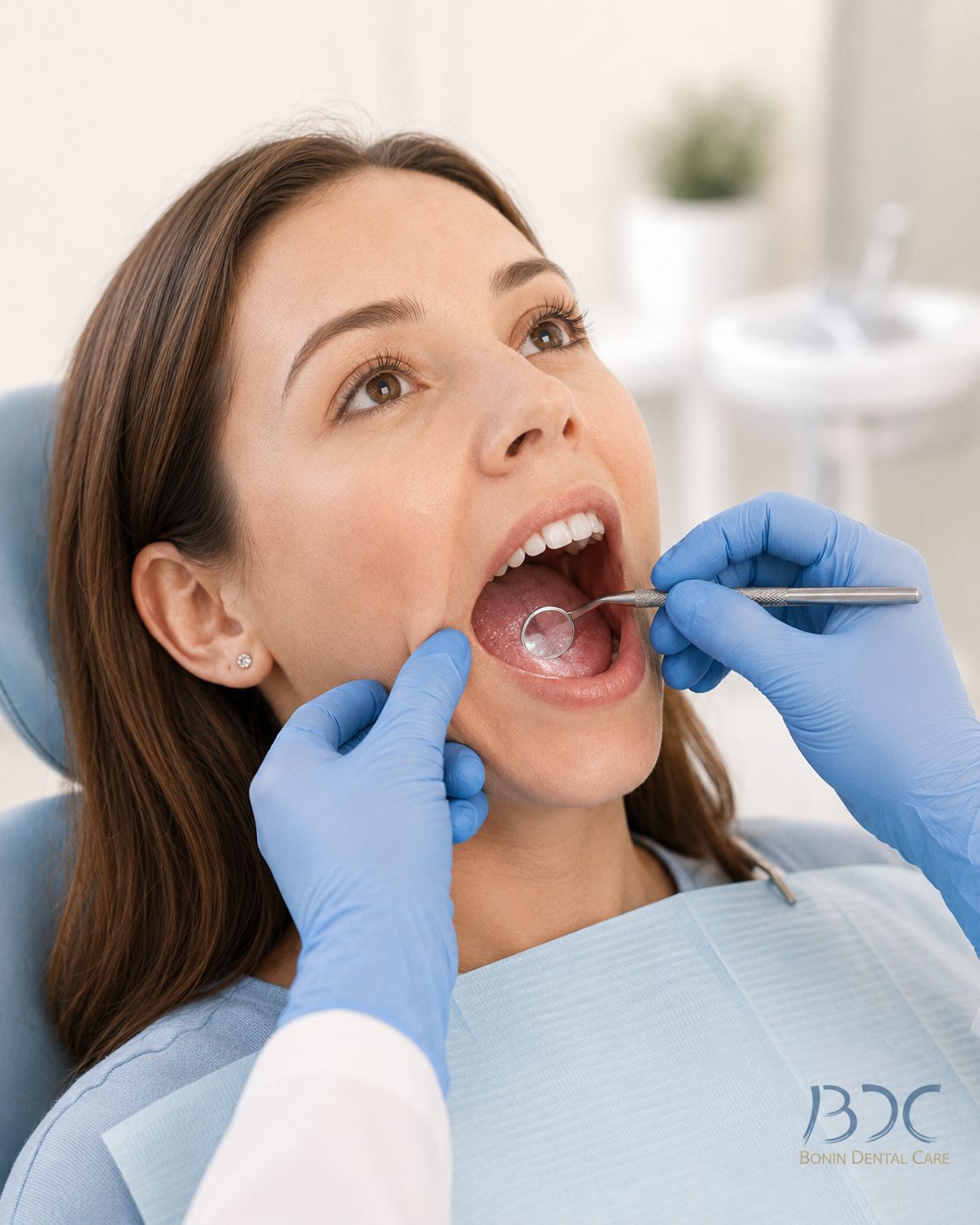
Oral cancer screening is comfortable and takes about five to ten minutes as part of your comprehensive exam. You'll recline in the treatment chair and Dr. Bonin will systematically examine your mouth using a handheld mirror, bright light, and his trained eye. He'll ask you to stick out your tongue, move it side to side, and open your mouth wide. He'll look at the roof of your mouth, the back of your throat, and the floor of your mouth (area under your tongue). You might feel him palpate your neck and jaw gently, checking for lumps or enlarged lymph nodes.
If Dr. Bonin wants to use the VELscope, you'll see a harmless blue light. It's not hot or uncomfortable; you'll simply see darker areas that indicate cellular changes. The light helps him identify spots worth monitoring or investigating further. If he finds something concerning, he'll explain what he sees, why it concerns him, and next steps. Most screenings identify nothing and provide reassurance. If a lesion or change is found, he'll discuss specialist referral and any monitoring plan.
What to Expect
Our Approach
Every visit follows a clear, considered sequence. No surprises, no guesswork.
- 1
Visual examination of your lips, inside of cheeks, gums, teeth, tongue, and roof of mouth under bright light.
- 2
Careful palpation (gentle feeling) of your neck, jaw, and floor of mouth to check for lumps or abnormalities.
- 3
Tactile examination of your tongue and oral tissues using a gloved hand to detect texture or thickness changes.
- 4
Assessment of your throat and lymph nodes for swelling or abnormal consistency.
- 5
Advanced imaging with VELscope if available and if Dr. Bonin wants to visualize deeper cellular changes.
- 6
Documentation of any findings in your chart with photos if abnormalities are noted.
- 7
Discussion of results and, if indicated, referral to an oral surgeon or otolaryngologist for evaluation.
Before You Decide
Costs, Insurance, And Timing
Oral cancer screening is covered by most insurance plans as part of a routine dental exam, though coverage varies. We verify your coverage when you schedule. If Dr. Bonin recommends a biopsy or specialist referral, that cost and coverage depends on the specialist and your insurance. We'll provide information about what to expect and help you understand coverage before you're referred.
Screening is most valuable when done regularly. Annual screening is a minimum. Patients at higher risk (tobacco users, heavy alcohol drinkers, those with previous abnormalities) might benefit from screening at every visit (typically twice yearly). Dr. Bonin will recommend a schedule based on your risk profile and findings.
FAQ
Oral Cancer Screening: Common Questions
Am I at risk for oral cancer?
What does oral cancer look like?
If something is found, does that mean I have cancer?
What is the VELscope and does it detect cancer?
How often should I be screened?
What happens if something suspicious is found?
Is oral cancer screening covered by insurance?
What can I do to reduce my oral cancer risk?
Have a question we did not cover? Reach out to our team.
Helpful Links
Explore related topics
Whether you are evaluating oral cancer screening for the first time or planning a comprehensive treatment that combines several procedures, the resources below answer the questions patients in Windsor and across Sonoma County most often ask before booking.
Related Care
About the Practice
Plan Your Visit
Available Across Sonoma County
Oral Cancer Screening for patients in these areas
Each link below opens a page written for that community, with drive times, local landmarks, and specific answers to the oral cancer screening questions we hear most from your area.
- Oral Cancer Screening for Healdsburg
- Oral Cancer Screening for Santa Rosa
- Oral Cancer Screening for Rohnert Park
- Oral Cancer Screening for Sebastopol
- Oral Cancer Screening for Cloverdale
- Oral Cancer Screening for Larkfield-Wikiup
- Oral Cancer Screening for Mark West Springs
- Oral Cancer Screening for Fulton
- Oral Cancer Screening for Forestville
- Oral Cancer Screening for Petaluma
- Oral Cancer Screening for Sonoma
- Oral Cancer Screening for Oakmont
- Oral Cancer Screening for Cotati
- Oral Cancer Screening for Guerneville
- Oral Cancer Screening for Geyserville
- Oral Cancer Screening for Fountaingrove
- Oral Cancer Screening for Rincon Valley
Related Services
Explore related care
General Dentistry
Comprehensive exams, professional assessments, and preventive strategies designed to catch problems early and keep your smile healthy.
Learn moreTooth-Colored Fillings
Tooth-colored composite fillings restore decayed teeth with materials that match your natural smile and bond to tooth structure.
Learn more