Porcelain Veneers
Custom porcelain veneers bond to your front teeth to fix color, shape, and minor alignment issues instantly.
About This Service
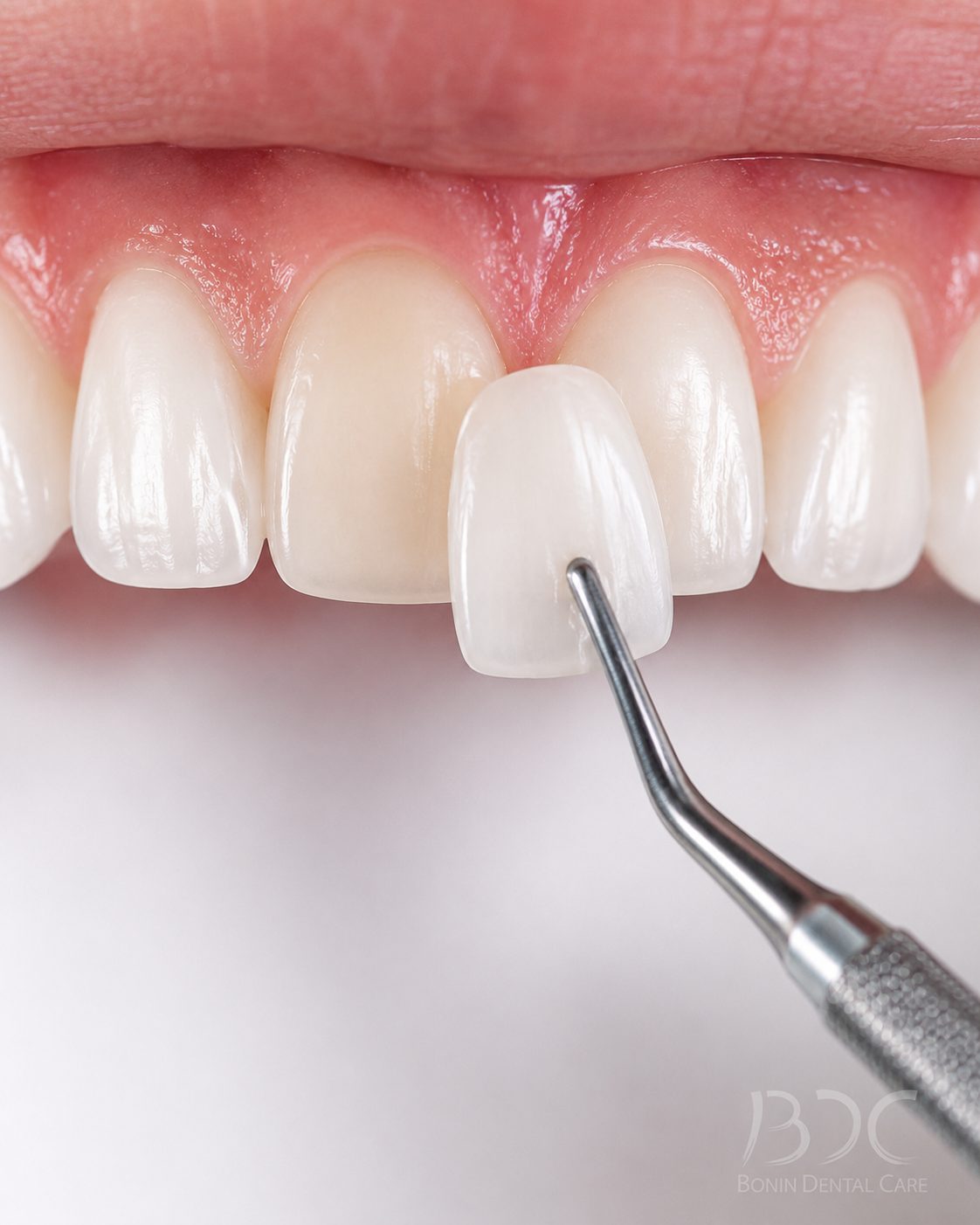
Porcelain veneers are thin shells of ceramic material bonded to the front surface of your teeth to change their color, shape, size, or alignment. If you have teeth that are stained, chipped, shaped oddly, or slightly crowded, veneers can transform how they look in just two appointments. Unlike crowns, which cover the entire tooth, veneers work on the visible front surface, so your natural tooth stays largely intact. Unlike Invisalign, which takes months, veneers deliver an instant dramatic change.
Veneers are popular with people who want a complete smile transformation but don't have time for months of orthodontics. They also work for people with permanent stains that whitening can't fix, or teeth shaped in ways that bonding alone can't address beautifully. The catch is that veneers are irreversible; Dr. Bonin must prepare your tooth by removing a small amount of enamel to make room for the veneer. Once that preparation is done, you'll always need something on that tooth. That's why the decision to get veneers is serious, and Dr. Bonin makes sure you understand what you're committing to.
At Bonin Dental Care, veneers are custom-designed and fabricated to match your natural tooth color and blend with your surrounding teeth and face. We use premium porcelain so they look as natural as possible, last for many years, and resist staining better than bonding does. The result is a smile that looks beautiful and, if done well, doesn't look like anything artificial was done at all.
Is This Right For You?
Who Benefits Most From Porcelain Veneers
Ideal candidates for veneers have healthy teeth and gums to start with. You might have teeth that are stained, chipped, oddly shaped, slightly gapped, or a combination. You need good oral hygiene habits because veneers are only as healthy as the tooth underneath them. Veneers work at any age, but they're particularly popular with working adults who want a fast smile transformation without the months-long commitment of Invisalign.
You're not a candidate for veneers if your teeth are severely crowded; Invisalign or braces would be a better first step. If your gums are unhealthy or receding significantly, Dr. Bonin will address those issues first because veneers need healthy gum support. If you grind your teeth severely, veneers may not hold up as well. Some patients with very thin natural enamel are better served with crowns instead. Dr. Bonin will be honest about whether veneers are right for your situation.
Our Approach
Why Patients Choose Bonin Dental Care For Porcelain Veneers
Dr. Bonin trained in cosmetic dentistry at USC and brings over 24 years of experience designing and placing veneers. He's a member of the American Academy of Cosmetic Dentistry, which means he stays current on veneer techniques and materials. He understands shade matching, tooth shape anatomy, and how to design veneers that complement your face and look completely natural. Some dentists place veneers that are too white or too perfect looking. Dr. Bonin's veneers look like teeth that belong to you, just better.
We use only premium porcelain for our veneer fabrication. The lab partners we work with in Sonoma County understand our high standards for shade, shape, and bite fit. Preparation is meticulous; Dr. Bonin removes just enough enamel to accommodate the veneer without compromising the tooth underneath. Bonding is careful and precise so veneers are secure and resistant to fracture.
When you choose Bonin Dental Care for veneers, you're choosing a dentist who has done this hundreds of times, who takes as much care with the shade and shape as a jeweler takes with a gemstone, and who will stand behind the result. Many patients drive from across Sonoma County and beyond because they trust Dr. Bonin's eye for cosmetic detail.
Patient Benefits
Why patients choose us for porcelain veneers
- Instantly improve tooth color, shape, size, and minor alignment in two appointments.
- Results look natural and blend seamlessly with your existing teeth.
- Resist staining much better than bonding or natural enamel.
- Create a complete smile transformation without months of orthodontics.
- Long-lasting results that hold up for 10-15 years or more with proper care.
- Address permanent discoloration that professional whitening can't fix.
What to Expect
From First Visit To Final Result
Your first appointment is the consultation. Dr. Bonin examines your teeth, discusses what you don't like about them, and explains what veneers can and can't accomplish. He shows you shade options and uses a digital mockup or temporary veneer shade guide so you see the predicted result before commitment. He's honest about the irreversible nature of veneers and ensures you understand that tooth preparation is permanent. Once you're ready, he schedules the preparation appointment.
On preparation day, Dr. Bonin numbs your teeth with local anesthesia so you're comfortable. He carefully removes a thin layer of enamel from the front surface of each tooth getting a veneer. You'll feel pressure and vibration but little to no discomfort because the area is numb. After preparation, an impression or digital scan is taken and sent to the lab. Temporary veneers are placed to protect your teeth and give you a preview of how your new smile will look. Temporary veneers are not as strong as permanent ones, so avoid hard or sticky foods.
One to two weeks later, you return for veneer placement. Dr. Bonin removes the temporaries, cleans the prepared teeth, and carefully places each permanent veneer, checking fit and shade before bonding. Once bonding is complete, he adjusts your bite and polishes everything. You'll walk out with a brand-new smile. Initial slight sensitivity to temperature is normal and typically resolves in a week or two.
What to Expect
Our Approach
Every visit follows a clear, considered sequence. No surprises, no guesswork.
- 1
Consultation where you describe your smile goals and Dr. Bonin evaluates tooth shape, size, color, and alignment to design a plan.
- 2
Digital mockup or shade matching to show you exactly what your new veneers will look like before any tooth preparation.
- 3
Tooth preparation: Dr. Bonin carefully removes a thin layer of enamel from the front surface of each tooth that will get a veneer.
- 4
Impression or digital scan of the prepared teeth sent to the lab for custom veneer fabrication.
- 5
Temporary veneers placed on prepared teeth while permanent veneers are being made.
- 6
Return visit for permanent veneer placement: each custom veneer is bonded to your tooth with strong adhesive.
- 7
Final adjustments to bite and appearance to ensure veneers feel comfortable and look perfect.
- 8
Review of aftercare instructions and scheduling of follow-up appointments.
Know Your Options
How Porcelain Veneers Compares To The Alternatives
Veneers vs Crowns
Both veneers and crowns change how a tooth looks, but they work differently. Veneers are thin shells that bond to the front surface; preparation removes a small amount of enamel from the front only. Crowns cover the entire tooth; preparation removes significantly more structure. Crowns are necessary when a tooth is heavily filled, broken, or needs root canal treatment. Veneers are ideal for cosmetic improvements to otherwise healthy teeth. Crowns last 10-15 years on average; veneers often last similarly. Cost-wise, veneers are usually less expensive than crowns. Choose veneers if your teeth are structurally healthy and you only want to change appearance. Choose crowns if the tooth is damaged or needs structural support.
Veneers vs Bonding
Both veneers and bonding use tooth-colored material to improve appearance. Bonding is a single-visit procedure where Dr. Bonin applies composite resin directly to your tooth, sculpts it, and hardens it with light. Veneers are two-visit; tooth prep is required, and a custom porcelain shell is fabricated at the lab. Bonding is less expensive and reversible. Veneers last longer, resist staining better, and look more natural for larger areas. Bonding works great for small chips or slightly closing a gap. If you want to transform multiple teeth or fix permanent staining, veneers are superior. Choose bonding for minor cosmetic issues. Choose veneers for comprehensive smile redesign.
Veneers vs Professional Whitening
Whitening brightens all your teeth uniformly by removing surface stains and internal discoloration. Veneers change shape, size, and color of individual teeth. Whitening is reversible and non-invasive. Veneers are permanent and require tooth prep. If your teeth are yellow from coffee or wine, professional whitening often solves it in one or two appointments. If your teeth are stained brown from medication (like tetracycline) or fluorosis, or if you want to completely reshape teeth, whitening won't help. Many patients whiten first to see if that achieves their goal, then consider veneers if they want additional improvements to shape or alignment. Whitening is usually a starting point; veneers are a more comprehensive solution.
After Your Appointment
Recovery And Long-Term Care
The first 24 hours after veneer placement are critical. Avoid hard, sticky, or very hot foods while the bonding adhesive fully cures. Don't chew your nails or ice. Your bite will feel normal because Dr. Bonin adjusted it during placement, but if something feels off, call the office. Slight sensitivity to temperature is normal and usually subsides within a week or two. If sensitivity persists, Dr. Bonin can apply desensitizing treatment to the tooth root.
Long-term care is straightforward. Brush and floss normally; veneers don't require special cleaning. Avoid habits that stress them, like using teeth as tools or chewing ice. If you grind your teeth at night, a night guard protects both your natural teeth and veneers. Avoid very hot or very cold foods in rapid succession because extreme temperature swings can stress the veneer-tooth bond. Come in for regular cleanings and exams every six months. Veneers typically last 10-15 years or longer with good care. If a veneer chips or bonds loosens, Dr. Bonin can repair or replace it.
Before You Decide
Costs, Insurance, And Timing
Veneer cost is driven by case complexity and the number of teeth being treated. A single veneer for one chipped tooth costs less than a full smile makeover on six or eight teeth. Premium materials and lab costs also factor in. Insurance doesn't cover cosmetic veneers, but we provide an itemized estimate before treatment begins. Patient financing options can spread cost across several months. Some patients choose to do a few veneers now and add more later as budget allows.
Treatment timeline is fast compared to Invisalign or braces. Your consultation takes about an hour. Preparation and impression is typically another hour or two. Fabrication takes one to two weeks at the lab. Placement is usually one to two hours. From consultation to finished smile is usually three to four weeks total. If you need temporary veneers or have special requests, timeline might extend slightly. Dr. Bonin will give you a specific estimate at consultation.
FAQ
Porcelain Veneers: Common Questions
Are veneers reversible if I change my mind?
How long do veneers last?
Can I whiten my veneers if they get stained?
What if I crack or chip a veneer?
Will my veneers look fake or too white?
Do veneers cover the whole tooth or just the front?
Will getting veneers hurt?
Can veneers fix crooked teeth as well as Invisalign?
Have a question we did not cover? Reach out to our team.
Helpful Links
Explore related topics
Whether you are evaluating porcelain veneers for the first time or planning a comprehensive treatment that combines several procedures, the resources below answer the questions patients in Windsor and across Sonoma County most often ask before booking.
Related Care
About the Practice
Plan Your Visit
Available Across Sonoma County
Porcelain Veneers for patients in these areas
Each link below opens a page written for that community, with drive times, local landmarks, and specific answers to the porcelain veneers questions we hear most from your area.
- Porcelain Veneers for Healdsburg
- Porcelain Veneers for Santa Rosa
- Porcelain Veneers for Rohnert Park
- Porcelain Veneers for Sebastopol
- Porcelain Veneers for Cloverdale
- Porcelain Veneers for Larkfield-Wikiup
- Porcelain Veneers for Mark West Springs
- Porcelain Veneers for Fulton
- Porcelain Veneers for Forestville
- Porcelain Veneers for Petaluma
- Porcelain Veneers for Sonoma
- Porcelain Veneers for Oakmont
- Porcelain Veneers for Cotati
- Porcelain Veneers for Guerneville
- Porcelain Veneers for Geyserville
- Porcelain Veneers for Fountaingrove
- Porcelain Veneers for Rincon Valley
Related Services
Explore related care
Cosmetic Dentistry & Smile Design
Personalized Smile Design combining porcelain veneers, Zoom in-office whitening, Invisalign, bonding, and custom crowns into one coordinated, high-end cosmetic result.
Learn moreInvisalign Clear Aligners
Nearly invisible clear aligners that straighten your teeth without metal brackets or wires. Discreet, comfortable, and proven.
Learn more