Full-Arch Dental Implants (All-on-4 / All-on-X, Coordinated with Specialists)
Full-arch restoration with All-on-4 or All-on-X implants. The surgical phase is performed by a trusted oral surgeon Dr. Bonin coordinates with, and Dr. Bonin designs and seats the final prosthesis at our Windsor office.
About This Service
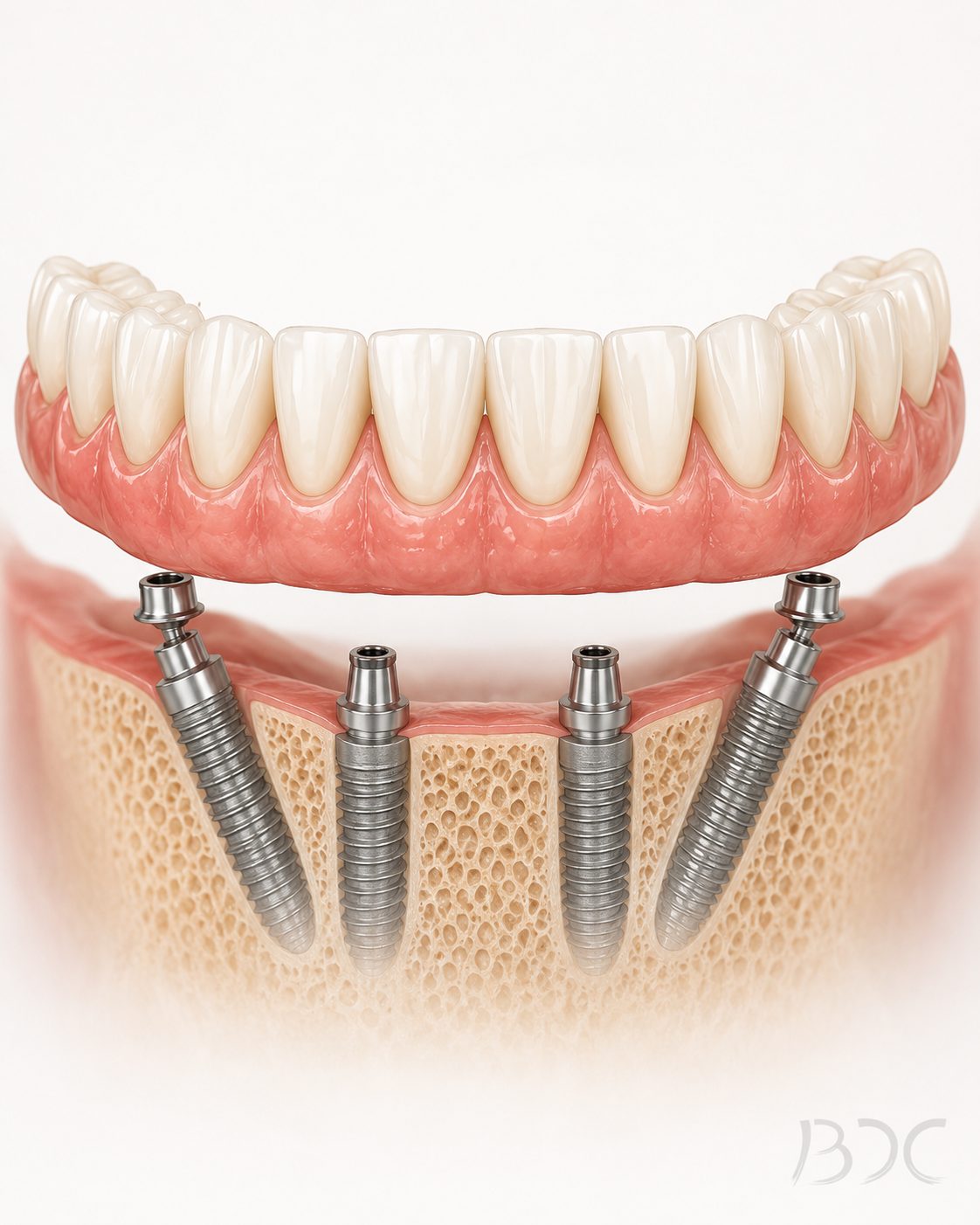
Losing all your teeth, or reaching the point where extraction is your only option, can feel devastating. A full-arch dental implant restoration gives you your life back. Instead of a removable denture, you get a full set of fixed teeth anchored to just four to six implants per arch. They don't come out. They feel and function like natural teeth. You eat, speak, and smile without worry.
A full-arch case is one of the most demanding procedures in dentistry, and the best outcomes come from a coordinated team: an oral surgeon or periodontist who places the implants using guided surgery, a prosthodontically focused restorative dentist who plans and seats the final bridge, and a lab that specializes in full-arch fabrication. At Bonin Dental Care, we want the best care for our patients, so we coordinate that team rather than try to do it all alone. The surgical phase is handled by trusted Sonoma County specialists whose practices are built around implant surgery and All-on-X protocols. The restorative phase is led by Dr. Bonin, who has built his career on complex restorative design.
Four implants (the "All-on-4" technique) positioned at precise angles can support an entire arch of replacement teeth. Some cases call for five or six implants (All-on-5, All-on-6) if bone density is compromised or if extra security is needed. After healing and integration, the bridge becomes your permanent solution. You brush and floss it like natural teeth, and it lasts for decades with proper care.
For patients in Windsor and throughout Sonoma County who've lived with missing teeth or ill-fitting dentures, full-arch implants are transformative. Some patients receive a same-day provisional (temporary teeth) on the day of surgery, so you leave the surgical office with teeth and can begin eating soft foods within days. Others wait for their bone to fully integrate before the permanent prosthesis is placed, which takes 3 to 6 months but ensures maximum stability. Dr. Bonin and the surgical specialist discuss the right approach for your bone, health, and timeline before treatment begins.
Is This Right For You?
Who Benefits Most From Full-Arch Dental Implants (All-on-4 / All-on-X, Coordinated with Specialists)
You're an ideal candidate if you're missing all or most teeth in one arch (or both), have moderate to good bone density, and are willing to commit to implant care. Age is less important than overall health; we've placed all-on-4 restorations in patients from their 40s to 80s and beyond. If you have controlled diabetes, heart disease, or other systemic conditions, implants can still work with careful medical coordination. Non-smokers heal faster and have better outcomes, but we can work with smokers who are committed to quitting during the healing phase.
You may not yet be a candidate if you have severe bone loss across the entire jaw, active gum disease, uncontrolled systemic conditions, or are taking medications that severely compromise bone healing (like high-dose bisphosphonates). We'll address those issues first. Some patients are candidates for immediate-load protocols (teeth the same day), while others need traditional healing (3 to 6 months with surgical sites closed before prosthesis placement). Your bone anatomy, density, and overall health determine which approach is right for you. During consultation, we'll show you your specific options.
Our Approach
Why Patients Choose Bonin Dental Care For Full-Arch Dental Implants (All-on-4 / All-on-X, Coordinated with Specialists)
Dr. Scott Bonin brings exceptional training and deep experience to every full-arch case as the coordinator and restorative dentist. He graduated from the University of Southern California School of Dentistry and completed a U.S. Navy General Practice Residency. He has 24 years of clinical dentistry, and he is an alumnus of Spear Education, a peer-group organization dedicated to advanced training in restorative and full-arch implant care. He understands every step of a full-arch case from imaging and planning through the final prosthesis.
The surgical phase is performed by a trusted oral surgeon or periodontist Dr. Bonin partners with for these cases. These specialists place full-arch implants every week, use guided surgery and live imaging, and have the volume and training to deliver predictable results in complex cases. Dr. Bonin coordinates the referral, sends imaging and treatment-planning records directly, and stays involved through healing. The restorative phase, where the final prosthesis is designed, fabricated, and seated, is performed at Bonin Dental Care with our prosthetics lab. We use FDA-approved implant systems and high-quality prosthesis materials: zirconia, porcelain-fused-to-zirconia, or acrylic-titanium hybrids depending on your specific case.
Patients choose Bonin Dental Care for full-arch restoration because we're direct about what All-on-4 and All-on-6 can and can't do, and because the team-based model delivers a better outcome than asking one office to do everything. The result is fixed teeth that restore function, appearance, and confidence at a level traditional or implant-supported dentures can't match. We've coordinated treatment for patients throughout Sonoma County who went from denture wearers or people with severely compromised teeth to people who eat, smile, and engage without self-consciousness. The quality of life improvement is remarkable.
Patient Benefits
Why patients choose us for full-arch dental implants (all-on-4 / all-on-x, coordinated with specialists)
- Surgical phase coordinated with a trusted oral surgeon Dr. Bonin partners with
- Final fixed prosthesis designed and seated by Dr. Bonin at Bonin Dental Care
- Fixed teeth that never slip, click, or move during eating or speaking
- Restored ability to bite and chew with the strength of natural teeth
- Long-term bone preservation (unlike dentures, which accelerate bone loss)
- Typically lasts 15 to 20+ years with proper care and professional maintenance
What to Expect
From First Visit To Final Result
Your first appointment is a comprehensive consultation at Bonin Dental Care. We take detailed 3D X-rays, examine your jaw and any remaining teeth, and discuss your goals and concerns. Dr. Bonin explains your treatment plan in detail, including how many implants you'll need, whether bone grafting is required, what the timeline looks like, and how the team-based care works. If you're interested in same-day provisional teeth, we discuss candidacy with the surgical specialist. We cover patient financing options, review insurance, and answer every question. Plan for 60 to 90 minutes.
If you need extractions, those are typically done the same day as implant surgery at the surgical specialist's office. On surgery day, you arrive calm with sedation already beginning. Under local anesthesia and your chosen sedation, the procedure typically takes 2 to 3 hours. You'll feel pressure, vibration, and water spray, but little to no discomfort. If you're getting immediate-load, a temporary prosthesis is seated the same day; you leave with teeth and soft-diet restrictions. If you're having traditional healing, surgical sites are closed and you go home without a prosthesis. You have a follow-up visit with the surgical office within one week.
Healing takes 3 to 6 months. During this time, if you have an immediate-load provisional, you're learning to live with your new teeth. There are check-in appointments at both offices to monitor healing and adjust the provisional. Once osseointegration is complete, you return to Bonin Dental Care for the restorative phase. Dr. Bonin designs the permanent prosthesis with our prosthetics lab, then seats it at our office. Taking impressions, designing the bridge, and placing the final prosthesis takes 4 to 8 weeks. From start to finish, immediate-load cases take 4 to 7 months; delayed cases take 5 to 8 months. Complex cases with significant bone grafting may take 9 to 12 months or longer.
What to Expect
Our Approach
Every visit follows a clear, considered sequence. No surprises, no guesswork.
- 1
Consultation at Bonin Dental Care: 3D imaging, exam, treatment goals, and team-based plan.
- 2
Coordinated referral to a trusted oral surgeon or periodontist for surgical planning, including any needed bone grafting or sinus lifts.
- 3
Extraction of any remaining teeth (if not already removed) at the surgical office, often the same day as implant surgery.
- 4
Implant surgery: 4 to 6 titanium implants placed into specific jaw positions by the surgical specialist under local anesthesia with sedation.
- 5
For immediate-load protocols, a temporary prosthesis is placed the same day; for delayed protocols, surgical sites are closed and allowed to heal.
- 6
Osseointegration over 3 to 6 months as bone integrates with each implant. We monitor with the surgical team.
- 7
Return to Bonin Dental Care for the restorative phase. Dr. Bonin designs the final prosthesis with our prosthetics lab.
- 8
Permanent prosthesis is custom-milled, then secured to the implants (cemented or screw-retained) at our office; bite, comfort, and esthetics finalized.
Know Your Options
How Full-Arch Dental Implants (All-on-4 / All-on-X, Coordinated with Specialists) Compares To The Alternatives
Full-Arch Fixed Implants vs Implant-Supported Denture
A full-arch fixed prosthesis is permanently attached (cemented or screw-retained) and never comes out. You brush and floss it like natural teeth. A traditional implant-supported denture snaps onto two to four implants and is removed daily for cleaning. Full-arch fixed restoration is more esthetic (no clasps or clips visible), more functional (no removable parts), and feels more like having real teeth. It also requires more implants (typically 6 or more versus 2 to 4) and costs more upfront. But if you want the closest experience to natural teeth and want to avoid the daily ritual of removing a prosthesis, full-arch fixed is the gold standard. If cost or bone limitations are concerns, an implant-supported denture is a strong alternative.
Full-Arch Fixed Implants vs Individual Implants Across the Arch
If you're missing all or most of your teeth, you could theoretically place an individual implant for each tooth you lost (8 to 12 implants total). This gives maximum esthetics and function but requires significantly more surgery, longer healing, substantially higher cost, and months or years of treatment. A full-arch prosthesis on 4 to 6 implants accomplishes nearly the same esthetic and functional result with a fraction of the complexity. Most patients facing tooth loss choose full-arch restoration over individual implants because the tradeoff between complexity and outcome isn't justified. Individual implants make sense for replacing a few scattered teeth; full-arch restoration makes sense for replacing an entire arch.
After Your Appointment
Recovery And Long-Term Care
For the first 24 to 72 hours post-surgery, expect swelling, bruising, and discomfort. Take pain relief as prescribed, apply ice to your face to reduce swelling, and eat soft foods (if you have a same-day provisional) or stick to liquids and pureed foods (if you don't have teeth yet). Avoid smoking, alcohol, strenuous exercise, and rinsing or spitting forcefully. If you're wearing a provisional prosthesis, avoid hard or sticky foods and be gentle when eating. Some bleeding from the surgical sites is normal. Call us immediately if you experience excessive bleeding, fever, severe pain, or signs of infection.
Long-term care is straightforward. Brush your fixed prosthesis with a soft toothbrush twice daily. Floss or use a water flosser around all implant-supported bridge work, paying special attention to the interface between the bridge and gums (where food and bacteria can accumulate). Come in for professional cleanings and check-ups every six months. Your bite and the prosthesis itself are monitored for any signs of wear or looseness. Eventually (typically after 10 to 15 years), the prosthetic teeth may show wear or the bridge may need replacement, but the implants themselves, if they've integrated successfully, can support a new prosthesis for decades. Avoid smoking and excessive alcohol, as these compromise bone health around implants. If you grind your teeth, wear a nightguard to protect your bridge.
Before You Decide
Costs, Insurance, And Timing
Cost is primarily driven by the number of implants (4 to 6), any bone grafting or sinus lift procedures, the material chosen for the prosthesis (zirconia is more durable; acrylic is less expensive), and the complexity of your case. A full-arch restoration is a significant investment, but it's typically less expensive than placing individual implants for each tooth. Most dental insurance plans do not cover implants or the prosthesis, though some plans may cover a portion. We file claims as a courtesy. Patient financing options are available to make treatment manageable. A detailed, itemized estimate is always provided before treatment begins, so you know exactly what to expect financially.
Timeline varies based on whether you choose immediate-load (same-day provisional) or traditional healing (delayed prosthesis). Immediate-load cases typically take 4 to 7 months from implant surgery to final prosthesis. Traditional healing takes 5 to 8 months. If you need significant bone grafting (like sinus lifts), add 4 to 6 months for graft healing before implant placement. Complex cases may take 9 to 12 months or longer. Dr. Bonin will provide a realistic timeline during your consultation based on your specific anatomy and choices.
FAQ
Full-Arch Dental Implants (All-on-4 / All-on-X, Coordinated with Specialists): Common Questions
Can I get teeth the same day of implant surgery?
How is a full-arch prosthesis different from a traditional denture?
What if I need a sinus lift or bone grafting?
Can I still eat normally with a full-arch prosthesis?
Will my full-arch prosthesis look like natural teeth?
How do I clean a full-arch prosthesis?
How long will my full-arch implant restoration last?
What if I smoke? Can I still get full-arch implants?
Have a question we did not cover? Reach out to our team.
Helpful Links
Explore related topics
Whether you are evaluating full-arch dental implants (all-on-4 / all-on-x, coordinated with specialists) for the first time or planning a comprehensive treatment that combines several procedures, the resources below answer the questions patients in Windsor and across Sonoma County most often ask before booking.
Related Care
About the Practice
Plan Your Visit
Available Across Sonoma County
Full-Arch Dental Implants (All-on-4 / All-on-X, Coordinated with Specialists) for patients in these areas
Each link below opens a page written for that community, with drive times, local landmarks, and specific answers to the full-arch dental implants (all-on-4 / all-on-x, coordinated with specialists) questions we hear most from your area.
- Full-Arch Dental Implants (All-on-4 / All-on-X, Coordinated with Specialists) for Healdsburg
- Full-Arch Dental Implants (All-on-4 / All-on-X, Coordinated with Specialists) for Santa Rosa
- Full-Arch Dental Implants (All-on-4 / All-on-X, Coordinated with Specialists) for Rohnert Park
- Full-Arch Dental Implants (All-on-4 / All-on-X, Coordinated with Specialists) for Sebastopol
- Full-Arch Dental Implants (All-on-4 / All-on-X, Coordinated with Specialists) for Cloverdale
- Full-Arch Dental Implants (All-on-4 / All-on-X, Coordinated with Specialists) for Larkfield-Wikiup
- Full-Arch Dental Implants (All-on-4 / All-on-X, Coordinated with Specialists) for Mark West Springs
- Full-Arch Dental Implants (All-on-4 / All-on-X, Coordinated with Specialists) for Fulton
- Full-Arch Dental Implants (All-on-4 / All-on-X, Coordinated with Specialists) for Forestville
- Full-Arch Dental Implants (All-on-4 / All-on-X, Coordinated with Specialists) for Petaluma
- Full-Arch Dental Implants (All-on-4 / All-on-X, Coordinated with Specialists) for Sonoma
- Full-Arch Dental Implants (All-on-4 / All-on-X, Coordinated with Specialists) for Oakmont
- Full-Arch Dental Implants (All-on-4 / All-on-X, Coordinated with Specialists) for Cotati
- Full-Arch Dental Implants (All-on-4 / All-on-X, Coordinated with Specialists) for Guerneville
- Full-Arch Dental Implants (All-on-4 / All-on-X, Coordinated with Specialists) for Geyserville
- Full-Arch Dental Implants (All-on-4 / All-on-X, Coordinated with Specialists) for Fountaingrove
- Full-Arch Dental Implants (All-on-4 / All-on-X, Coordinated with Specialists) for Rincon Valley
Related Services
Explore related care
Restorative Dentistry
Comprehensive restorative dentistry rebuilds multiple teeth using crowns, bridges, fillings, implants, and strategic planning.
Learn moreDental Crowns
A crown is a custom-made restoration that fully covers a weakened or broken tooth, restoring strength, appearance, and function. Includes implant-supported crowns coordinated with our surgical partners.
Learn more